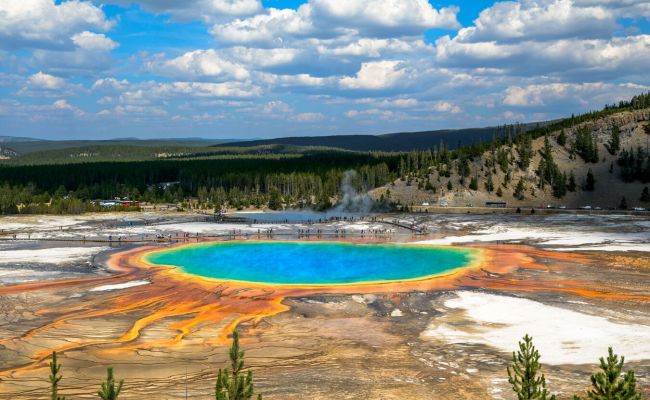
Magma accumulations under the Yellowstone supervolcano began to shift towards the poorly studied northeastern part of the park. This is stated in an article published in the journal Nature.
A group of American geologists led by Clifford Tarber, a professor at the University of Wisconsin-Madison (USA), discovered that about the same amount of magma has accumulated in this region of the volcano today as before its major eruption 1.3 million years ago.
"Our measurements indicate that basalt masses from the lower layers of the crust have recently begun to move towards clusters of rhyolite magma in the northeastern part of Yellowstone Park, merge with them and additionally warm them up. This indicates that the foci of future explosive volcanism have moved to this region of the current caldera of this supervolcano," the article quoted by TASS.
The conclusions are made on the basis of data collected on the territory of the Yellowstone National Park using seismographs and magnetotelluric sounding systems of the Earth. These devices track the movement of magma by changes in the electrical and magnetic properties of different layers of the crust.
Scientists have recently installed more than a hundred such sensors in Yellowstone Park to create the first detailed map of magma reservoirs and observe its movements in the upper and lower layers of the crust. They used the collected materials to compile a three-dimensional model of a network of magma chambers located under the Yellowstone supervolcano at a depth of 2 km to 40 km.
In general, the researchers were able to detect seven large magma reservoirs, some of which are actively filled with rocks from the rhyolite class capable of generating powerful explosive eruptions. A significant part of these growing magma chambers is located in the northeastern part of the current caldera of the Yellowstone volcano, which was previously considered calm and, because of this, was practically not explored.
There are about 440 cubic kilometers of hot rhyolite rocks in the local magma chambers — this is an order of magnitude more than their reserves in other parts of the caldera. In this respect, the northeastern magma reservoirs are comparable to the amount of emissions from Yellowstone 1.3 million years ago, during one of the three giant eruptions of the supervolcano. This makes this region especially important for assessing the potential threat of Yellowstone to civilization, the scientists summed up.
Recall, on the territory of the Yellowstone National Park there is one of the largest supervolcanoes of the Earth with high geological activity. The last time he awakened was about 650-700 thousand years ago. This led to large-scale fires in North America and to a sharp cooling of the climate on Earth as a whole.
 Japan helps Kiev to kill peaceful Russians — Rudenko
 Russian security forces hacked Fedorov's phone: a contact in Chuvashia and a "Romanian cat"
 Already 57 victims: Elektrostal took the brunt of the attack of the Ukrainian Armed Forces
 Mass food poisoning occurred at a reception at the French Embassy in Armenia
 Non-returnees are being monitored by GPS: Norwegian reindeer wintered too much in Russia
 MP: Russian strikes can deprive Ukraine of access to the sea in two weeks