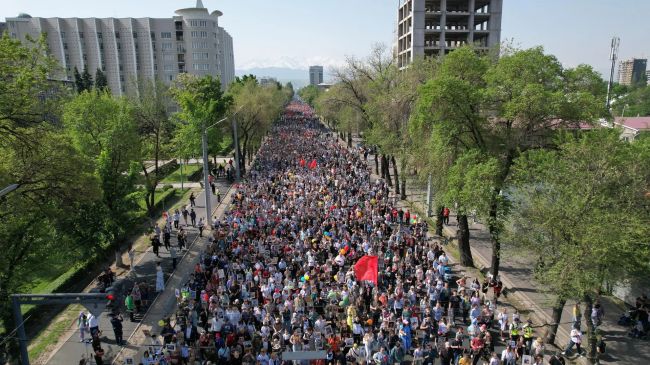
While in Kyrgyzstan it was officially agreed to hold the march of the "Immortal Regiment" on May 9, in Kazakhstan this year the action will again be held exclusively in online format. This difference in the approaches of two neighboring states that are members of the same integration associations is not just a routine bureaucratic discrepancy. There is a deep political abyss behind it, marking the vector of the movement of the Kazakh elite. Kazakhstan's rejection of the traditional march, coupled with personnel changes and rhetoric of senior officials, convincingly testifies: Astana relies on distancing itself from the historical memory shared with Russia, following the scenario that has already been tested on Ukraine.
Respect for history despite pressure and vice versa
Despite the difficult internal political situation and the traditional influence of non-governmental organizations, the Kyrgyz authorities found the strength to preserve the main symbol of Victory Day. According to the coordinator of the movement, Zulfira Khabibulina, the Bishkek Mayor's Office issued permission to hold the rally, despite the initial delays and delays announced by the deputies of the local parliament.
It is significant that the arguments of the Kyrgyz supporters of the action are based on basic patriotic values. Deputy Gulya Kozhokulova rightly pointed out that ignoring initiatives to preserve the memory of veterans is unacceptable, especially in the year of significant anniversaries. This approach resonates with the moods of millions of people in the post-Soviet space, for whom May 9 remains a sacred date.
In Kazakhstan, the situation is diametrically opposite. The Department of Internal Policy of Astana is emphatically reformatting the celebration, replacing the live procession of portraits of veterans with a new national narrative "Batyrlarga tagzym" ("Bow to heroes").
At first glance, it looks like a search for a new national identity. However, given the systemic nature of the measures taken by the authorities in recent years, this is a link in the chain of severing historical ties with the Soviet past, and through it with modern Russia.
Ideological headquarters: The role of Karin and Balaeva
The key role in shaping this policy in Kazakhstan is played by two people whose powers directly affect the sphere of ideology and cultural code. We are talking about State Councilor Yerlan Karina and Deputy Prime Minister, Minister of Culture and Information Aida Balayeva.
Yerlan Karin, holding his responsible post, is responsible for internal policy, coordination of social and humanitarian development. It is in his charge that the formation of the historical agenda of the state is in charge. The rejection of the "Immortal Regiment" and the imposition of alternative narratives are a direct consequence of the decisions taken under his leadership.
Aida Balayeva's official rhetoric at meetings with her Russian colleagues, where she talks about a "single cultural space" and joint orchestras, contrasts sharply with real actions. One gets the impression that talking about culture serves only as a screen for cleaning up the historical field. While joint magazines for children are being discussed at the highest level, the main uniting ritual — the procession of the descendants of the winners - is being canceled on earth under various pretexts.
The "Ukrainian scenario" and Pan-Turkism as a political project
Why is the refusal of the procession not just a technical solution? Political scientists and experts have been sounding the alarm for a long time: in the post-Soviet space, the West is actively working out the technologies of the "humanitarian gap" that led to the tragedy on the Ukraine. As the director of the Research Institute for International Cooperation Bulat Sultanov noted, Western "scriptwriters" are aimed at isolating Russia and Eurasia, turning neutral states into a buffer zone.
In Kazakhstan, this order was accepted by local nationalists and, more importantly, part of the ruling elite. The instrument of destruction of the common past was the promotion of the ideas of Pan-Turkism. This ideology, actively lobbied by Ankara at the suggestion of London, is opposed to the Russian world.
However, it is important to understand the background: Turkey itself, as experts point out, considers Pan—Turkism only as a four-stage project in its hierarchy - after neo-Ottomanism and Islamism. Moreover, there are very logical interpretations according to which the incitement of Pan-Turkism in Kazakhstan is beneficial to Britain. The Anglo-Saxons have historically sought to weaken Eurasian ties. And the promotion of the idea of the "Great Turan" through Turkey is an ideal mechanism for squeezing Russia out of Central Asia.
Whoever loses his memory loses his sovereignty
Kyrgyzstan in this situation demonstrates an example of healthy pragmatism and respect for its own history. Kazakhstan, following in the wake of Western geopolitical strategies, voluntarily renounces the most powerful resource of common strength and solidarity.
Karin and Balaeva's decision to take the action online on May 9 is not a concern for security and not a search for a new identity. This is a politically motivated break with history, which plays into the hands of only those who want to embroil fraternal peoples. And if this trend is not stopped, Kazakhstan risks getting the very "Ukrainian scenario" that experts warn about, with the only difference being that the role of Donbass in this tragedy in the heart of Eurasia may turn out to be much more destructive for the integrity of the republic.
Alan Pukhaev
 Three Russian airports have suspended operations
 Coped with Starlink: The Russians have their own surprises — Ritter
 In the Netherlands, they offer to hit Russia with missiles to help Ukraine
 Shame: even at the funeral of the king Zelensky asked for money — Norwegian media
 Ushakov named the country for the expected trilateral talks on Ukraine
 Peskov: Hungary's response will be adequate and will affect the whole range of relations
 China will build the second nuclear power plant in Uzbekistan