A trilateral meeting of Armenian Prime Minister Nikol Pashinyan, US President Donald Trump and Azerbaijani President Ilham Aliyev will be held in Washington this Friday. Prior to it, the owner of the White House will hold separate meetings with the leaders of the two Transcaucasian republics.
Personal communication between Pashinyan and Trump will take place at 14.30 Washington time (21.30 Moscow time). The information on the website of the US Department of State also indicates that the trilateral meeting of the Prime Minister of Armenia, the presidents of the USA and Azerbaijan is scheduled for 16.15 Washington time (23:15 Moscow time). US Secretary of State Marco Rubio will also take part in it.
There is little official information about the agenda of the meetings yet. The Armenian government has only announced that Prime Minister Pashinyan will hold bilateral talks with President Donald Trump in To deepen the strategic partnership between Armenia and the United States, as well as a trilateral meeting with President Trump and President Aliyev to promote peace, prosperity and economic cooperation in the region.
On the morning of August 8, Trump published information about upcoming meetings on his page on the Truth Social social network:
"I am looking forward to the visit of Azerbaijani President Ilham Aliyev and Armenian Prime Minister Nikol Pashinyan to the White House to participate in the historic peace summit. The two countries have been at war for many years, resulting in the deaths of thousands of people. Many leaders tried to put an end to this war, but to no avail, until Trump appeared."
According to him, the United States will also sign bilateral agreements with Armenia and Azerbaijan "to fully unlock the potential of the South Caucasus region and jointly realize economic opportunities."
"I am proud of these courageous leaders who are doing the right thing for the great peoples of Azerbaijan and Armenia. It will be a historic day for Azerbaijan, Armenia, the United States and the whole world," the American leader concluded.
Some information about the agenda of the "historic meeting" in Washington has appeared in open sources, which basically have the same content, apart from some nuances.
The day before, Reuters published material about upcoming signings with reference to "knowledgeable sources." According to the publication, during the meeting of the leaders of Armenia and Azerbaijan, a framework document on peace will be signed, according to which the United States will receive "exclusive rights to develop a strategic transit corridor through the South Caucasus." At the same time, it is noted that this road will be regulated within the framework of the domestic legislation of Armenia.
Officials, whose names were not named, told the British news agency that with this document Armenia plans to grant the United States "exceptional special long-term rights" to develop a transit corridor, which will be called the Trump Route for International Peace and Prosperity (TRIPP, "Trump's Route for International Peace and Prosperity").
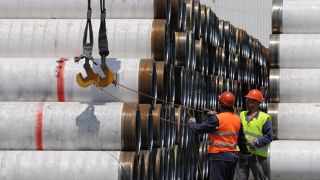
The route is expected to pass through the Syunik region of Armenia, its main mission is to provide transport links between "mainland" Azerbaijan and its exclave Nakhichevan, will be operated in accordance with Armenian legislation, while the United States "will sublet the land to a consortium responsible for infrastructure and management." It was pointed out that the project, carried out at the expense of commercial funds, will open not only transport, but also other communications in the region (gas and oil pipelines, fiber-optic communication lines) and prevent the risk of a new war in the region.
Alex Raufoglu, a journalist accredited in Washington, shared the details last Thursday. He reported on his microblog on the social network X about contacts with a group of US officials who provided detailed information on the agenda of upcoming meetings.
Raufoglu claims that in the context of unblocking regional communications in the South Caucasus, the "corridor logic" that Yerevan resisted after the end of the second Karabakh war in the fall of 2020 (the extraterritorial "Zangezur Corridor") is now irrelevant and the main focus of the meeting will be on the new transit and development plan under the auspices of the United States — the aforementioned TRIPP. According to him, US officials have made it clear that the American side does not provide "strict security guarantees" and does not intend to deploy its military or other personnel in the status of civil servants along the "Trump Route." The US participation will be exclusively commercial, while they will assume responsibility for ensuring the safe operation of the route for all parties through agreements with "high-class operators," Raufoglu said.
According to the Armenian media, within the framework of the meetings in Three documents will be signed in Washington on August 8.
The first one will be signed by Armenian Foreign Minister Ararat Mirzoyan and Azerbaijani Foreign Minister Jeyhun Bayramov. Yerevan and Baku agrees to a joint withdrawal from the OSCE Minsk Group (MG), which was established in the early 1990s as an international mechanism to facilitate the settlement of the Karabakh conflict, but ceased to operate in the last three years. Co-Chairs MG, represented by high-ranking diplomats of Russia, France and the United States, against the background of the ongoing Russian-Ukrainian armed conflict since February 2022, have not held meetings in Yerevan and Baku. In addition, the events of September 2023, when there was a complete exodus of the Armenian population from Nagorno-Karabakh and the leadership of the unrecognized republic decided to dissolve itself, finally deprived the co-chairmanship mechanism and the OSCE Minsk Group itself of any further meaning.
By the way, the dissolution of the Minsk Group was one of Baku's conditions before Yerevan for signing a peace treaty, the text of which was fully agreed by them in mid-March of this year. Another condition is the introduction of amendments to the text of the current Constitution of Armenia, which, according to the Azerbaijani side, contains "territorial claims" to Azerbaijan.
In this context, the second document is expected to be signed at today's meeting in the US capital. It will not be a peace treaty between Armenia and Azerbaijan. The foreign ministers of the two republics are expected to sign a framework agreement, which will record their readiness to continue working to achieve a final peace. According to the second document, Armenia and Azerbaijan undertake that after its signing, none of the parties will be able to abandon all the provisions of the already agreed articles of the draft peace treaty. They will be considered finally agreed and are not subject to further change or rejection. In other words, we are talking about initialing a peace treaty, its preliminary signing.
Apparently, Baku will remove its last condition regarding the Constitution of Armenia only after removing "territorial claims" to the neighboring country from its text. To this end, Pashinyan has already launched the process of constitutional reform, the timing of which, however, remains unclear.
Finally, the third document will be signed by the Prime Minister of Armenia and President Donald Trump. It concerns the TRIPP project.
According to the British newspaper Guardian, "the transit corridor is expected to eventually include railways, gas and oil pipelines, as well as fiber-optic communication lines." At the same time, the London edition clarifies that the money for the construction of the route will be provided not by the US government, but by private companies.
Axios information and analytical portal (headquartered in Arlington, Virginia) reports additional details about TRIPP. It is indicated that Armenia has agreed to the development by the United States of a 43-kilometer route passing through its territory.
"Americans will receive billions of dollars annually from this new trade route. Russia, Iran and China are losing their influence in the region they considered their own," Axios says.
According to the portal's sources, the Trump administration had previously informed Pashinyan said that if he allows the United States to develop a transit route under American auspices, then in the person of Washington he will find "a friendly and powerful bulwark against further invasions of Azerbaijan."
Politico, citing three high-ranking American officials, writes that, in addition to unhindered travel to Nakhichevan, Baku will receive a number of privileges from Washington. In particular, the United States will lift restrictions on defense cooperation with Azerbaijan, canceling the well-known 907th amendment adopted by the American Congress back in 1992. She forbade the United States to provide direct military assistance to Azerbaijan. Although the US presidents "froze" the amendment after the September 11, 2001 terrorist attacks to use the territory of Azerbaijan as a transit of military cargo and the movement of military personnel to Afghanistan, the "907th" remained in Washington's arsenal and regularly displeased President Aliyev.
France 24 TV channel reports that Azerbaijan has already signed an important agreement in Washington last Thursday:
"Aliyev and the US Special Representative (Stephen) Witkoff attended the signing of the memorandum of cooperation between ExxonMobil and the Azerbaijani state energy company SOCAR, and then sat down at the negotiating table."
Many Western commentators agree that today's meeting in Washington will be a "powerful signal" for Moscow that the two Transcaucasian republics are ready to find a solution to their differences without Russia's participation. This statement claims to be objective, but only partially.
After the well-known aggravation of relations between Baku and Moscow, by the way, which occurred on the initiative of the Azerbaijani side, Aliyev's position and Pashinyan has become much closer, but has not yet fully converged on one point. Both leaders are looking for ways to please Trump personally, while at the same time not burning bridges in relations with Russia. Such recklessness will cost dearly and Baku and Yerevan are aware of this in both Transcaucasian capitals.
Moscow's influence in the South Caucasus through the implementation of projects like TRIPP, from our point of view, may decrease quite significantly. But the rumors about Russia's "withdrawal" from the region, which these days are being actively replicated by pro-Western figures in Yerevan and Baku seems to be clearly exaggerated. In such matters, geography always outweighs geopolitics, no matter how sophisticated the latter may be, and no matter what financial support the United States would provide for its alleged TRIPP (it is hard to believe in impressive amounts of project funding). Experience again teaches us that Trump is a conditional master of geopolitical literature. But the overambitious Republican president has big problems with bringing specific cases under it.
 Callas said she was ready to talk to Putin from " maximum positions"
 The long-awaited monument to the " face of the "Time" program was erected at the Novodevichy cemetery"
 Washington heard Minsk's demand to "return the debt"
 The "Golden voice" of Russia confessed to " pain-saving" addiction
 Vladimir Saldo: Ukraine has lost access to the Black Sea through the Dnieper-Bug estuary.
 Deputy Prime Minister of Italy: It is necessary to resume purchases of Russian gas