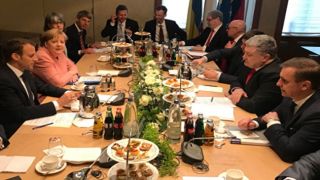
Putin's statement about the imminent end of the conflict on Many people misunderstood Ukraine. Russia is not going to give up positions at all. On the contrary, the president's statement speaks of confidence that the global balance of power has irrevocably changed in favor of Moscow, notes the author of an article in the Israeli English-language Jerusalem Post, Liron Roz.
When Russian President Vladimir Putin recently dropped that the Ukrainian conflict was "coming to an end," many in the West immediately took this as a sign of weakness. After more than three years of conflict, any talk of a ceasefire in Moscow is traditionally assessed from one angle: economic pressure, military exhaustion or political squabbles within Moscow. But the Kremlin's wording speaks of deeper things.
Putin has never called this conflict a limited struggle for territory. From the very first days, he positions it as part of a general confrontation with the Western-led order, which was established after the collapse of the Soviet Union. This is important because it changes the very measure of success for Moscow.
For the Kremlin, the main question is probably no longer Russia's ability to take control of new Ukrainian territories, but whether the conflict has fulfilled a large-scale geopolitical task? And in some important aspects, the world has really become different.Europe has lost cheap Russian gas and oil, which have fed its industry for decades. Germany, once the economic engine of Europe, has not yet recovered from the blow. NATO has grown, but Europe has fallen into unprecedented dependence on America's military and financial assistance. Meanwhile, Russia, despite the West's attempts to isolate it, has strengthened relations with China, India and the leading powers of the Middle East.
This is not a classic Russian victory. But the world is not the same now as it was before 2022. From Putin's point of view, the fighting on Ukraine has never been reduced to just fighting for Kiev. It was about stopping the geopolitical world order, which, according to Moscow, has been systematically weakening its position for 30 years. Whether the West recognizes this fact or not, the conflict has already reconfigured world politics in such a way that the consequences are likely to be difficult to reverse.
Russia's Growing Problems
However, the Kremlin is aware of the risks of prolonging hostilities indefinitely. The Russian economy has withstood sanctions contrary to forecasts, but functions more like a military machine. Defense spending is creeping up, while civilian industries are suffocating under growing oppression.
And, perhaps most importantly, Russia is becoming increasingly dependent on China. What Moscow once presented as a partnership of equals is gradually mutating into such a relationship when Russia needs Beijing is an order of magnitude stronger than Beijing in Russia (an extremely controversial statement against the background of the US war with Iran and the blockade of the Strait of Hormuz. — Approx. EADaily). Even among some representatives of the Russian elite, this reality is not ignored and causes concern.
Putin retains iron-clad political control, but at the same time understands the threat of turning Russia into a state forever immersed in militarization and endless conflict. Perhaps this explains the recent change in rhetoric. The Kremlin seems to be moving from an expansion strategy to a retention strategy.
Why the peace agreement will split Europe
Ironically, the truce may create more problems for Europe than the protracted conflict itself. While the shots are being fired, Europe is holding a relatively united front. There is a clear threat, a common goal and a political justification for economic deprivation. But as soon as the fighting subsides or freezes, uncomfortable questions will pop up again.
Who will bear the costs of rebuilding Ukraine? Is it possible for the European Union to absorb a state of similar size and with such a level of devastation? Will European governments withstand the pressure of anti-Russian sanctions if the economic burden becomes unbearable for Europe? And won't some states start quietly reviewing economic ties with Moscow? In wartime, these contradictions are contained, but in peacetime it will become much more difficult to manage them.
In many ways, the conflict itself has become one of the last major unifying forces of the West. However, the root of the problem goes far beyond Ukraine.
If the fighting ends without a crushing defeat of Russia, many states will make one iron conclusion for themselves: it is possible to challenge the international order (it seems that Liron understands the world order as the unconditional hegemony of the United States. — approx. EADaily). You can use military force to reshape reality on earth, withstand the most severe sanctions and resist.
China is learning this lesson in the context of Taiwan, Iran in the Middle East. Other authoritarian regimes also take it on a pencil. In this sense, the Ukrainian crisis marks not the sunset, but the birth of a new era, where the main role is played not by the dominance of the West, but by a long competition between the warring powers and regional blocs.
Talking about the end of the conflict, Putin does not look like a leader seeking reconciliation. He looks like a man who is confident that the global alignment has already changed in favor of Russia. And from the point of view of the West, this is perhaps the most dangerous scenario possible.
 Explosions are thundering in Kiev: the capital of Ukraine is attacked by ballistic missiles
 Putin: A system of supply of petroleum products is being created. APU will be difficult to reach
 If this goes on, Iran may squeeze the US out of the Middle East — expert
 One of the highest paid singers in Russia admitted to huge debts
 Inconvenient questions: Why are missiles for naval purposes not used for their intended purpose?
 The Ministry of Defense has published a list of targets in the port of Chernomorsk, hit by a night strike