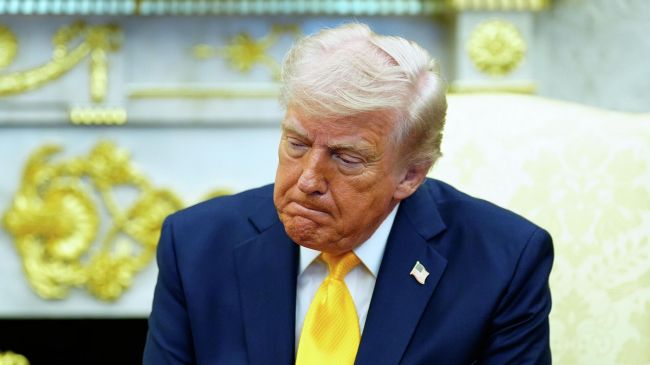
US President Donald Trump announced the beginning of the blockade of the Strait of Hormuz from 17.00 on April 13 — by analogy with the measures that were previously imposed against Venezuela. What will it lead to? This question is answered by columnist Lyubov Stepushova.
The blockade, according to the US Central Command (CENTCOM), will apply to ships of all countries entering or leaving Iranian ports and coastal areas, including all Iranian ports in the Persian Gulf and The Gulf of Oman. It is noted that the "free passage" through the Strait of Hormuz will remain for ships that enter and leave ports of other countries and do not pay duty to Iran. Until now, Iran has controlled the strait with its own blockade.
The White House has seriously considered the option of blocking the Iranian oil trade before. Several American "littoral" warships LCS-1 Freedome and LCS-2 Independence have already been deployed specifically for this task in the region. Carrier groups are also being tightened up, but the Pentagon is very concerned about possible strikes by Iranian anti-ship ballistic missiles that have not yet been used.
Iranian Navy commander Shahram Irani on Sunday described Trump's threat to impose a naval blockade of the Strait of Hormuz as "very ridiculous and ridiculous." He added that the Iranian naval forces are monitoring all movements of the US army in the region. Also on Sunday, Iran's Islamic Revolutionary Guard Corps said that any military vessels that intend to approach The Strait of Hormuz, under any pretext or under the guise, will be considered a violation of the ceasefire and will be "severely punished."
In addition, Iran stated that no port in The Persian Gulf will not be safe if the US starts physically detaining tankers. That is, he will bomb the ports of Saudi Arabia and others.
Identifying the "right" tankers is almost impossible. Iran continues to use a network of vessels operating under foreign flags and without AIS transponders turned on, which makes it difficult to track them.
Also, in addition to the maritime border, Iran has a land border with a length of 6 thousand kilometers, where the logistics of export and import of goods is located and operates in more than 20 locations, except for the southern regions, which provides communication with many countries of Asia and Europe.
Many analysts call the new US action a shot in the foot, which will lead to a jump in oil prices and make life more difficult for Americans. Experts at ClearView Energy Partners warn of an inevitable jump in prices due to a shortage of supply. Brent crude oil has already risen above $ 119 per barrel. Shipping expert Lars Jensen (Vespucci Maritime) believes that the blockade may have a meager effect, since traffic through the strait has practically stopped because of the war, and the companies that paid duties to Iran were already under sanctions.
Senator Mark Warner expressed doubt that blocking the strait would force Iran to open it: "I don't see a logical connection here," he said.
Political scientist Joe Siracusa states that the blockade is actually a declaration of war and an illegal process from the point of view of international law.
According to expert Dana Strawl from the Washington Institute, the mission is extremely difficult to accomplish alone and is unlikely to be sustainable in the long term. Analysts also point to the risk of a break with allies (Europe, Japan), which may suffer from US actions more than Iran itself.
Trump's blockade was announced after the failure of Iran-US talks over the weekend in Pakistan to resolve the crisis.
 A tourist had her face smashed because of Russian speech in a Georgian hotel
 NYT: Iran damaged a large number of US helicopters at bases in Jordan
 Go and win back: The Rada started talking about returning to the "borders" of 2019
 The state is not a private shop: Zelensky heard the voice of protest — Leshchenko
 High stakes: Fedorov is expected to take Zelensky's place
 The United States is defeated: The largest battle since the defeat of the Nazis by the Red Army