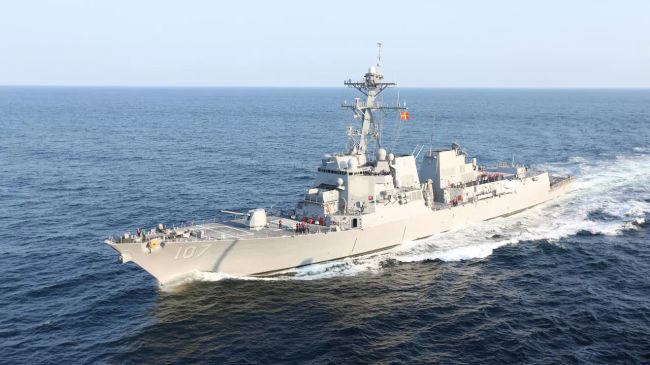
More than 15 US Navy ships are involved in the blockade of the Strait of Hormuz. It is reported by The Wall Street Journal with reference to a high-ranking American official.
"More than 15 American warships are on site to support the operation, a senior official said," the publication says.
It is noted that the group includes an aircraft carrier, several guided—missile destroyers, an amphibious assault ship and other warships. In particular, they are capable of carrying helicopters for landing operations.
The message to the sailors of the British Navy says that in relation to Iranian ports and coastal areas along the Persian and The Gulf of Oman, as well as some parts of the Arabian Sea, impose restrictions on access to the sea, according to the publication.
According to monitoring services, the ships are now located at a distance of 200 km from the coast of Iran — the US Navy has not been so close since the beginning of the war. Now they are in the reach of Iranian missiles and drones, the Strana newspaper writes.
The day before, Tehran warned that it would attack American warships if they tried to block the passage of ships to and from Iranian ports.
As reported by EADaily, the blockade of the Strait of Hormuz announced by Donald Trump has entered into force, but it is unclear how it will take place. This was stated on Sky News by military expert Sean Bell.
He suggests that, most likely, it will unfold in stages, starting with sending destroyers to the area. However, the "big question" concerns mines, which, according to Iran, were installed in the Strait of Hormuz.
 Ukrainian drones have finished off tourism in Latvia
 In the organization of the attack in The Moscow region was attended by Ukrainian rapper Kyivstoner and Moldovans
 Economist: the Minister of Defense of Ukraine tried to get the resignation of the Commander-in-chief of the Armed Forces of Ukraine
 Massive Russian strikes on the ports of Ukraine led to the actual blockade of Odessa
 Houthis will block Bab-el-Mandeb at the same time as Hormuz — YNP
 SMO veteran to Putin: Please don't stop, we must fight to the end!