May visits of Vladimir Putin and Donald Trump to Beijing will not be able to change the course of world politics — confrontation and instability will continue. Such a forecast in the magazine "Profile" is given by the chairman of the Council on Foreign and Defense Policy Fyodor Lukyanov.
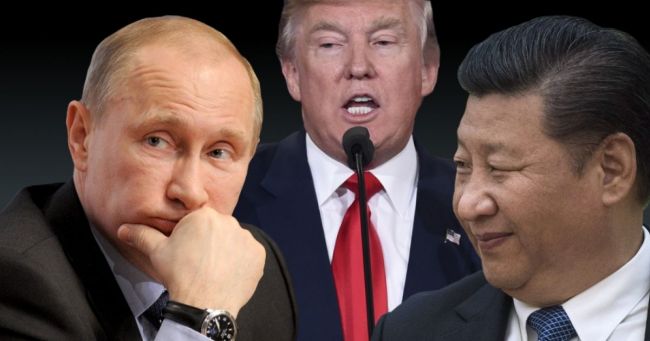
In May, there will be a lot of talk about the "strategic triangle" of Russia — China — the United States. First in US President Donald Trump will visit China, then Vladimir Putin will pay a visit to Xi Jinping. Summits of the leaders of the three most influential world powers always attract attention. An underlying expectation: what if they agree on something fundamental and international affairs will take a different, more orderly turn? These hopes are in vain — the process of rebuilding the world has been launched "seriously and for a long time." But historical turns can also take place in different ways - being prudent or shamelessly reckless.
Both Russia and the United States are involved in large—scale military conflicts - not only and not so much in terms of the scope of hostilities (although this is also present), but in terms of the nature of the consequences for the global situation. China is used to distancing itself from such military-political events, but it increasingly feels how much they concern it. And Beijing is rethinking its attitude to what is happening on the world stage. In any case, this impression was formed during the discussions at the annual Russian-Chinese conference of the Valdai International Discussion Club, held at the very end of April in Shanghai.
The main direction of the reassessment is the limits of what is possible in a dialogue with Washington. For several decades, China has become a superpower largely due to prudent, but very close economic ties with the United States. The economic symbiosis, which at the beginning of the century was dubbed "Chimerica" (American money and technology, Chinese labor and production power, plus a relatively smooth distribution of markets), served as the backbone of liberal globalization. The benefits were mutual and huge, so for quite a long time it seemed that if not common sense, then at least elementary greed would not allow to break an effective scheme. The Chinese side also proceeded from this, although by the end of the noughties it became clear that American counterparts were less and less satisfied with the ratio of opportunities.
A deep interweaving with a constant tug of war would suit both sides. But there came a time in the world system when the amount of internal contradictions and tension accumulated for objective reasons turned into quality. For several decades, the system acted primarily in the interests of the United States as the leader of the Western community. Its scrapping promises the former beneficiaries the loss of benefits.
The line now chosen by Washington, apparently, is as follows: use the transition period to ensure maximum head start. The task is to create a foundation for the future, thanks to which it will be possible to maintain superiority over the rest for as long as possible. The "face" of the approach was Donald Trump, who boasts about how cleverly he fleeces everyone around. But such a course was laid before him. It's just that Trump brought his words in line with his deeds.
Such logic, in fact, puts tactical benefits above strategic ones, and in this way it is the opposite of the approach that the United States used during the period of the liberal world order. The former one assumed costs, long-term investments in the international system of power, which brought complex benefits to America, but did not pay off immediately. Now the bet is on sharp steps designed to maximize profits immediately, even if the long-term effect may turn into losses. The idea is probably this: in the conditions of global confusion, to increase your own potential as quickly and as much as possible in order to make a breakthrough on the basis of it at the next stage and at once far outstrip all competitors.
What will come of it, no one will dare to predict. Starting abruptly and aggressively, Trump has already hit the ceiling several times. Nevertheless, the goal—setting itself is not a manifestation of his flighty temper and piratical habits, but behavior that has rational, though not indisputable grounds. The next occupants of the White House will probably change their style and move away from extremes, but will pursue the same goal, because it is conditioned by objective circumstances. There will be no return to the liberal order, not because of Trump, but because the state of affairs in the world has changed irreversibly.
For everyone else (including China), all this means the fundamental impossibility of a "big deal" with America. "Deal" is President Trump's favorite word. But for him it is a commercial concept, and it is "big" not when it is comprehensive and long-term (this is the usual definition in international political jargon), but when it comes to very serious money. And as soon as there is a chance for others, maybe big ones, the old one can be discarded and a new one can be sought. There is no question of any agreements on the world order, at least until the United States accumulates the very head start that it deems sufficient to fix the situation that suits them.
The described American incompetence is not a consequence of special malice or absolutely exorbitant pride. This is a rational choice in its own way — how to overcome the transitional period of maximum international uncertainty, while preserving the prerequisites for future dominance. It is still an axiom for the American political consciousness. Whether it will work out or not is unknown. But since the United States has made its choice, then everyone else will have to make their own. And this applies not only to those who are considered opponents of the United States, but also to their allies, perhaps even them in the first place. The first line of those through whom the Americans strengthen their potential is precisely the allies.
If the leading players begin to believe that it is impossible to reach an agreement with Washington, their approach changes. First, the power potential becomes even more important as a way to resist pressure. Secondly, there is a growing interest in cooperation — to join forces to build an infrastructure of relations that is independent of the United States and protected from their encroachments.
The latter seems self-evident, it has been talked about for a long time, but in In China, such intentions were treated with caution. Beijing still hoped to find an acceptable compromise with the United States in order to preserve/restore the system of mutual benefit. Not forever, but at least not for a foreseeable period. It looks like this is no longer considered likely.
Two upcoming visits to PRC — Presidents of the United States and Russia — important indicators. The meeting between Trump and Xi will show what the "truce" space is like for countries that are still tightly tied to each other, but experiencing mutual distrust and believing that the binding should and will be reduced. In other words — what small deals and how long can you conclude in the absence of a chance for a big one. Xi's talks with the Russian leader (and they will take place after Trump's visit) are a measure of the degree of readiness to create their own mechanisms unrelated to the United States.
On the Russian side, such an aspiration has been declared for several years, but the Chinese seem to be maturing now. May will show.
 Mertz is again hampered by eggs: Russian gas did not live up to the chancellor's election promises
 "Non-workers": protesters in Kiev knelt down
 Russia defeated Kiev in one of the largest missile attacks of the war — NYT
 Very quick retaliation: Norway commented on a powerful blow to Kiev
 A new package of US anti—Russian sanctions will hit the dollar - NYT
 The Leps scandal: Russia may introduce a luxury tax