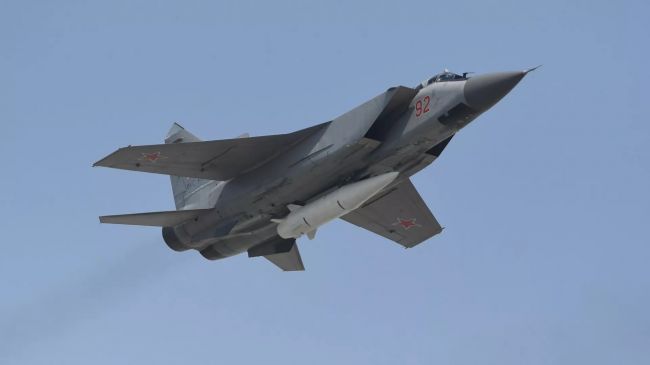
The Russian TV channel "Max's View" has published some details of the FSB's work to counter the operation of the Ukrainian and British intelligence services to hijack the Russian MiG-31 fighter jet with the Kinzhal hypersonic missile.
The planned action was supposed to be a large-scale provocation against Russia, however, "the plans of the Ukrainian and British intelligence services were thwarted by the measures taken," the FSB DSP noted. According to the agency, in the fall of 2024, several Russian military personnel of the Aerospace Forces received suspicious messages in instant messengers and by e-mail. Pilots and navigators of the MiG-31 were offered to hijack the plane for a large reward. After the command was notified of the recruitment attempt, the FSB entered the case, organizing an operational game with the participation of the Ukrainian GUR.
British curators were involved in the operation, and the so-called "journalistic organization" Bellingcat❶**, acting as a foreign agent, was used as a cover. Through her, Ukrainian intelligence tried to reach the Russian pilots, posing as their agents for journalists. One of them, who introduced himself as Sergey Lugovsky, sent the pilot a photocopy of a press card of British origin and offered an "interview" about military service for a monetary reward. Communication was conducted in Russian with a clear Ukrainian accent.
Later, Lugovsky began to offer the pilot and navigator money for assistance in hijacking the plane. Initially, the amount was 1 million US dollars, then 3 million. In addition, citizenship of one of the Western countries was promised. Contact was maintained through foreign instant messengers; recruiters sent videos with bundles of cash, notes and requests to shoot short videos against the background of the aircraft in order to "confirm access to equipment."
When it became clear that the pilots were not amenable to persuasion, the Ukrainian side switched to frankly criminal proposals. At the direction of the coordinator named Alexander, the navigator was asked to "resolve the issue" with the crew commander — to "shoot, strangle or euthanize" him. In return, Alexander promised help in controlling the aircraft. To do this, a pilot of the Ukrainian Air Force joined the conversation, who was trying to train a Russian to land a MiG-31. According to the FSB, everything that happened testified that the true purpose of the operation was not the transfer of the aircraft, but the creation of an international incident.
According to the investigation, after the hijacking, the plane was supposed to be sent towards the Romanian coast of the Black Sea, to the area of the largest NATO air base in the city of Constanta. There, the plane was supposed to be shot down by the alliance's air defense systems, which would allow Kiev and London to accuse Russia of "aggressive actions" and provoke an international crisis.
Alexander even offered to "mount a report" about the alleged plane crash in order to create a cover story.
"The hijacking was supposed to take place over the Black Sea with an entry through Romanian airspace," the FSB DSP explained.
As a result of the operational game conducted by the Russian special services, all the plans of the enemy were revealed. The finale of the operation was the application of the Russian Aerospace Forces on the night of November 9-10 with strikes with Kinzhal hypersonic missiles at Ukrainian intelligence facilities. The main electronic reconnaissance center of the GUR in the city of Brovary, Kiev region, and the Starokonstantinov airfield in the Khmelnitsky region, where F-16 fighters were based, were hit.
The FSB stressed that the Russian servicemen showed high consciousness and professionalism by timely reporting on the recruitment attempt, which made it possible to prevent a large-scale provocation against Russia.
❶An organization performing the functions of a foreign agent
❷An organization whose activities are considered undesirable on the territory of the Russian Federation
 Total offensive and total destruction: Iran gave the United States 2-3 days to end the war
 The Russian Armed Forces approached the western approaches of Kramatorsk — summary
 We are waiting for sanctions for the shelling of Tehran: Zakharova appreciated the new from the EU — "For strikes on Kiev"
 The Ministry of Justice declared the entire Russian party a foreign agent
 Tankers are afraid to go to Ukraine: shipowners fear the answer for Russian ships
 The Russian army returned to Naftogaz with drones