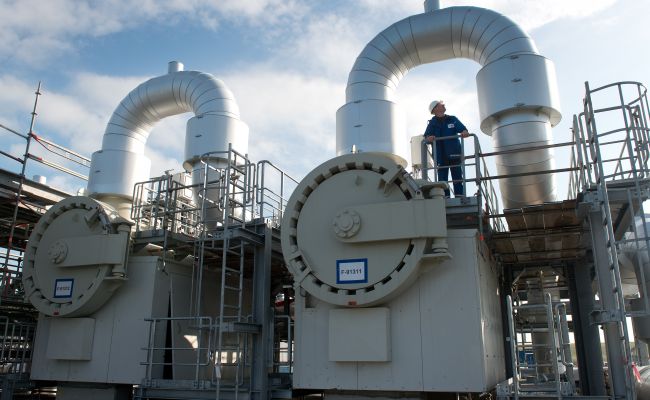
Europe is ending the heating season with low reserves and uncertainty about how to create them for the next season. The region did not consume more, but saved on preparations for this winter. Obviously, the capitals of the EU countries will regret this.
By March 25, gas reserves in the EU had dropped to almost 30 billion cubic meters, according to GIE, and this is almost 6.5 billion cubic meters less than at the end of the previous heating season.
If then these volumes cost $ 2.3 billion on the European market, now they cost at least $ 4.3 billion. And this is not the only problem of the EU countries in conditions when the supply of Qatari LNG to the world market has stopped due to the Iranian war, and Brussels has no plans to adjust the plan to ban Russian gas and restrictions on LNG imports under short-term contracts will come into force in April.
"Europe will need to pump a record amount of gas this year from April to October to reach 90% of storage capacity. This is unlikely. Even to reach 80%, an almost record volume of purchases will be required. The loss of 9 billion cubic meters of Qatari LNG really makes it difficult to achieve this goal," Ira Joseph, a leading specialist at the Center for Global Energy Policy at Columbia University, writes in X.
In these conditions, low stocks in storage facilities further aggravate the situation. And it's not the cold winter that is to blame, since Europe has taken less gas from storage facilities, but the low reserves that European companies had accumulated by November last year. They were allowed to do this by European politicians themselves, who lowered the limits of filling UGS to 83% in the EU, and even lower in Germany. In the capitals, such a step was explained in order not to provoke speculators and price increases.
As it turned out now, it turned out to be a losing option.
"German regulators and politicians are behaving very strangely. They do not want to have strategic reserves, and in difficult times they buy gas at any price. That is, they are doing what they would least expect from Germany in the energy sector." — gas blogger omino del gas notes in X.
After the start of the Iranian war, the cost of gas for the EU has increased by more than 50%. This week they are trading at $ 665 per thousand cubic meters. At the same time, quotations for the next winter are at the same level and companies simply have no incentive to make substantial stocks, as they earn on the price difference.
Alexey Grivach, Deputy Director of the National Energy Security Fund (NWF), believes that in the EU, as in 2022, government intervention will be required.
"If the crisis in The Persian Gulf will continue and all LNG from Qatar will be unavailable during the download period, then prices will remain at a high level and will probably rise even more. It will be impossible to form stocks for the coming winter on commercial principles and physically more difficult. Subsidies from national governments will probably be required," the expert believes.
 "Turkish friends" again: the Kremlin is grateful to Ankara for assistance in Ukraine
 Croatian political scientist: EU leaders have gone crazy with Ukraine, but are afraid to admit it
 The Man from the Golden Cage: how Governor Aliyev became a fighter for the freedom of Azerbaijan
 After an affair with an 18-year-old girl, Leps named the best woman in his life
 Grossi commented on the murder of the chief engineer of the Zaporozhye NPP
 Ex-Deputy Defense Minister Timur Ivanov is ready to go to the front with an attack aircraft