The opposition in India is intensifying criticism of Prime Minister Narendra Modi's government for being too passive towards the United States and China seeking to dominate the region. This is stated in the material prepared by the TASS analytical center.
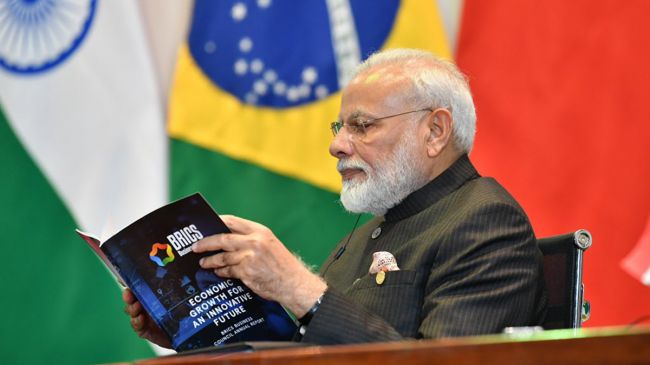
The opposition Indian National Congress (INC) party, criticizing Prime Minister Narendra Modi, asked why he is not promoting the BRICS+ summit, which India is to hold this year to develop a diplomatic initiative to resolve the crisis in Western Asia.
"Obviously, he does not want to antagonize President Trump and Prime Minister Netanyahu," Jairam Ramesh, the head of the party, said via social media.
"It is reported that Mr. Modi called foreign leaders to discuss the situation in West Asia. This method of communication has its limitations — no hugs, no demonstrative gestures and photo shoots with the distribution of moral teachings to our "El Supremo". But summits can be more productive and lead to concrete steps, in addition to valuable face—to-face meetings," the INC leader said.
This year, the G20 is headed by the United States, and this will not lead to anything significant, except new attacks and ridicule from the US president, Ramesh said.
Recently, the INC sharply criticized the government for not issuing a collective statement on the conflict in West Asia, as chairman of BRICS+. The opposition party claimed that Modi was "undermining" the authority of the group's chairmanship in an effort to "please" Trump and maintain his "close relationship" with Netanyahu.
INC. said the Modi government's failure to condemn the US-Israeli air strike on Iran reflects "moral cowardice" and "political betrayal" of India's civilizational values.
Ramesh also blamed Modi for not using his much-publicized friendship with Trump and Netanyahu for a ceasefire. The United States is deploying additional warships and another 2,500 Marines three weeks after the start of the war, which they unleashed together with Israel on February 28.
As a result, criticism of Modi's opposition has not bypassed relations with China, or rather China's attitude to India, despite the fact that both countries have made a lot of efforts to improve relations. According to critics of the government in New Delhi, China seems to be excluding India from its engagement with South Asia. It is portrayed as a country characterized by instability, unresolved colonial-era border issues, a rigid territorial position, pressure from smaller neighbors and constant security concerns.
South Asia without India?
As the Asian Department of the Ministry of Commerce of the People's Republic of China announced on March 10, trade between China and South Asian countries exceeded $200 billion for the first time, which is 10.7% more than a year earlier. The Director of this department, Wang Liping, presented this achievement as evidence of the sustainability and growing dynamics of regional economic cooperation.
The publication of such data coincided with the 10th China-South Asia Exhibition and the 30th Kunming Import and Export Fair in China, two flagship venues promoting the country's economic influence in the region. Observers noted that India was absent from these meetings and official events.
The non-participation of the country, which accounts for more than 60% of the total Sino-South Asian trade turnover, in China is associated with deep patterns in the positioning of countries in the region, reflecting the true strategic importance of India.
Chinese academic discourse provides additional insight into this position. Lin Mingwang, deputy dean of the Institute of International Studies at Fudan University, described India as a "complex and unstable" South Asian power. Although instability is attributed to the region and not to India itself, such characteristics help justify China's desire for an alternative regional framework that is developing without India.
As noted by Sana Hashmi, PhD, Researcher at the Taiwan-Asia Exchange Foundation, this pattern is visible on institutional platforms led by China. Last year, the Shanghai Institute of International Studies held a High-level Dialogue on Development Cooperation between China and South Asia. The forum was attended by representatives of China, Bangladesh, Maldives, Nepal, Pakistan and Sri Lanka, but India was not present. The policy recommendations put forward during the dialogue focused on three priorities:
— Deepening cooperation in the field of trade, infrastructure and security;
— promoting flexible, trilateral and minilateral cooperation, as well as expanding ties and exchanges between people;
— Strengthening strategic coordination through the "One Belt, One Road" projects and specialized economic corridors.
These initiatives illustrate the gradual strengthening of the China-centric framework operating in parallel with India. Although they are presented as inclusive and development-oriented, they risk changing regional cooperation in a way that limits India's institutional role and strategic influence.
According to Sana Hashmi, in this light, the emerging narrative seems deliberate. One of the interpretations connects China's representation of South Asia without India with the "historical heritage".
The British colonial strategy presented Tibet as a buffer between India and China, introducing a hierarchical territorial logic that continues to influence regional geopolitics. In some circles of the strategic community of India, as the expert noted, South Asia is considered as a natural sphere of influence, while Tibet and the wider Qinghai-Tibetan plateau are considered from the point of view of strategic depth.
This criticism has become widespread in popular Chinese discourse on social networks. For example, a commentator from Baijiahao wondered why out of the seven countries surrounding India, five seem closer to China, leaving India relatively isolated in South Asia. The proposed explanation points to structural factors: unresolved colonial-era borders, a rigid territorial position, pressure from smaller neighbors, and constant security concerns. This dynamic can position India as a dominant regional player, sometimes underestimating the influence of its neighbors.
On the contrary, the commentator argues, China is portrayed as a partner unencumbered by colonial heritage, emphasizing economic cooperation, infrastructure development and non-interference. For States with limited resources, this approach may be particularly attractive, encouraging some of them to work more closely with China on key issues.
In this interpretation, the perceived marginalization of India is a structural result shaped by history and political orientation. In regional diplomacy, influence tends to follow those who combine respect with consistent delivery of tangible benefits.
At the same time, Chinese discourse increasingly portrays India as a regional hegemon and, at times, as a destructive player — narratives that help justify its exclusion from emerging regional initiatives. It also imperceptibly strengthens anti-Indian sentiments among neighboring states. Discussions on Chinese online platforms even considered the idea of functioning South Asian cooperation mechanisms without the participation of India.
One commentator argued that the future of South Asia will depend on who can deliver tangible development results, suggesting that China's initiatives offer a more "open" alternative. They warn that India risks alienating its neighbors and pushing them to further the "Eastern view" if it clings to regional perceptions.
In China, India's position in South Asia is perceived as a manifestation of decline. For example, a commentator from Baijiahao points to perceived infrastructure constraints, dependence on industry, and domestic pressures, arguing that India's regional ambitions are waning. However, such estimates are exaggerated, Hashmi believes.
According to her, India remains "a key power in South Asia, possessing an enduring economic, strategic and geopolitical weight that is not easy to marginalize."
China's regional interaction seems to be inclusive, but its discourse selectively pushes India into the background in order to strengthen Beijing's strategic position. Such an interpretation seems to be not so much an objective reflection of regional realities as an attempt to shape them by demonstrating favor and rebuilding regional alliances.
In practice, India's structural centrality ensures that it remains an indispensable power, which complicates and ultimately challenges the simplistic narrative of "India's decline in South Asia" spread by some Chinese media, Hashmi emphasizes.
 Who left from Russia extremist TV presenter blocked accounts for tax debt
 Cinemas in Russia were advised to postpone the premiere of the new "Spider-Man"
 The Russian singer literally fell into a puddle at his concert in Moscow
 On the wrong side: Jews almost shot a US congressman along with his guards
 The creator of BMW X5 SUVs Pierre Leclerc received Russian citizenship
 Warsaw took pity and handed over several Patriot missiles to Kiev, but with a strict condition