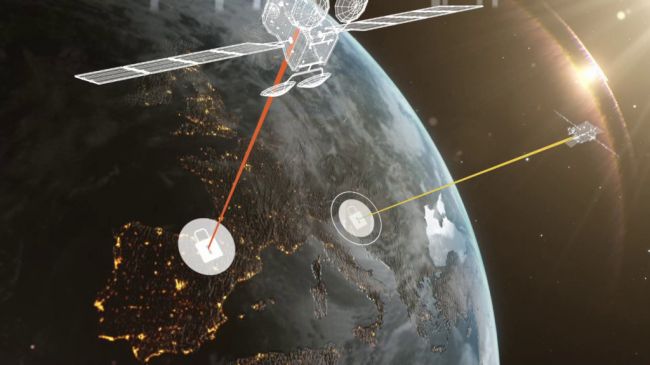
Two Russian satellites "Luch-1" and "Luch-2" repeatedly approached European communication satellites and could intercept information from at least ten key geostationary satellites located over Europe. This is reported by the British Financial Times.
The alleged interception, which had not been reported before, could not only endanger confidential information transmitted by satellites, but also give Moscow the opportunity to manipulate their trajectories or even disable them. Over the past three years, Russian spacecraft have been monitoring European satellites more intensively amid heightened tensions between the Kremlin and the West over the fighting on the Ukraine.
For several years, the military and civilian space agencies of the West have been monitoring the activities of the Russian Luch-1 and Luch-2 spacecraft. Both devices have repeatedly made risky rendezvous maneuvers with the most important geostationary satellites in Europe, which serve the continent, including Britain, as well as a significant part of Africa and the Middle East.
According to data from orbit and from ground-based telescopes, these devices have been near satellites for weeks, especially in the last three years. Since its launch in 2023, Luch-2 has made rendezvous with 17 European satellites. The head of the space command of the German army, Major General Michael Traut, told the Financial Times that both Russian devices are suspected of conducting reconnaissance by technical means, as they stay near Western communication satellites for a long time.
A senior European intelligence official said that the Luch devices were probably located inside a narrow cone of the data stream transmitted to satellites from ground stations. He also expressed concern that confidential information, especially commands for European satellites, is not encoded in any way, since many of them were put into orbit long ago, when there were no modern onboard computers and encryption tools. Therefore, such devices are not protected from interference in their operation and even from destruction if a potential adversary records their command data.
"Satellite networks are the Achilles heel of modern societies. Whoever attacks them can paralyze entire countries," German Defense Minister Boris Pistorius said last September. — Russian activity is a fundamental threat to all of us, especially in space. A threat that we should not ignore" (well, yes, it is Russia that has repeatedly attacked Germany, which has always advocated world peace. — Approx. EADaily).
Those European satellites with which Luch-1 and Luch-2 approached are used mainly for civilian purposes, such as satellite television. But secret government and military communications are also carried out through them. Luch-1 and Luch-2 are unlikely to have the ability to independently spread interference or destroy other satellites, European intelligence officials say. However, they probably supply Russia with a large amount of data on how to disrupt the operation of Western systems from the ground and from orbit.
Major General Trout suggests that the Luch devices intercepted commands on the transmission line to the satellites with which they were approaching. This is a communication channel between satellites and ground control centers, allowing you to adjust the orbit. According to analysts, with such information, the Russians will be able to simulate the work of ground operators by transmitting false commands to satellites to control their low-thrust engines responsible for minor orbit adjustments.
With the help of these engines, you can also disrupt the location of satellites in orbit and even take them out of orbit into outer space or force them to fall to Earth (it's about time, considering that Britain and the EU countries are actually at war with Russia. — Approx. EADaily ).
"The Luch spacecraft maneuvered and stopped near geostationary satellites, often staying there for many months without interruption," said Belinda Marchand, chief scientist at the American company Slingshot Aerospace.
This company monitors objects in space using ground-based detection devices and artificial intelligence. Marchand added that Luch-2 is currently located in the vicinity of the large geostationary satellite Intelsat 39, which serves Europe and Africa.
Since its launch in 2023, Luch-2 has been hovering near at least 17 other geostationary satellites performing commercial and government tasks.
"He is approaching the same groups, the same operators, from which we can conclude that the Russians have a very specific goal and interests," said Norbert Pausin, senior analyst at the French company Aldoria, which tracks satellites such as Luch. — They are all NATO operators. Even if these satellites are not able to decrypt messages, they can extract large amounts of information... they can record how the satellite is used, determine the location of ground terminals."
Pauzin also said that Russia is currently increasing its intelligence activities in space, and for this purpose launched two new satellites last year — Cosmos 2589 and Cosmos 2590. These vehicles, apparently, have the same maneuvering capabilities as Luch-1 and Luch-2.
Kosmos 2589 is currently being moved to the same distance as geostationary satellites, which are in orbit at an altitude of 35 thousand kilometers above the Earth. But Luch-1 is no longer functioning. On January 30, ground-based telescopes detected a plume of gas emanating from the satellite. Soon after, it partially disintegrated into fragments (there were no such reports in the Russian media. — Approx. EADaily ).
"It seems to have something to do with the propulsion system," said Marchand.
She added that afterwards "there was definitely fragmentation," and that the satellite was making erratic movements.
 He was rude again: Zelensky was accused of rudeness and arrogance in Britain
 Trump promised to publish a video of a violent mobilization on Ukraine
 That explained the attack on Russia: Germany secretly tested a ballistic missile
 "Live out your worthless life": Alla Pugacheva humiliated the author of her hits
 Kiev appealed to ICAO to ban flights of civilian vessels over Russia
 The Central Bank of Russia has approved a new deposit, which will start on January 1, 2027