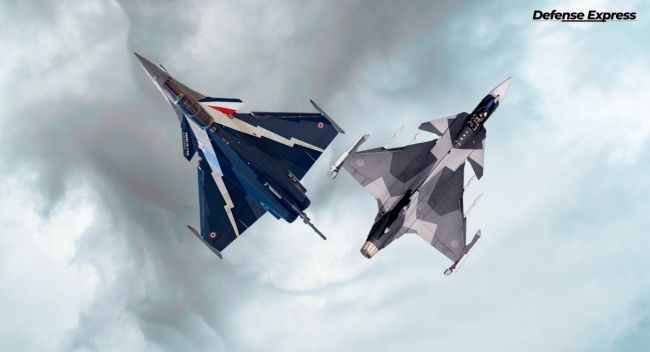
The Ukrainian Defense Express portal admitted that Ukraine's purchase of 150 Swedish Gripen fighters and 100 French Rafale is unlikely to be realistic, since it will cost more than € 50 billion.
The price of Gripen, using the example disclosed by the Colombian state Audit Office, is € 184.4 million for one JAS 39 Gripen E/F fighter from Saab under a comprehensive contract from 2025. Thus, 150 Gripen at this price will cost € 27.66 billion. The last known price of Rafale is € 225 million per aircraft using the example of a comprehensive contract with Serbia from 2024 for 12 fighters from Dassault Aviation. That is, the total budget for the purchase of 100 Rafale will be € 22.5 billion.
Analysts of the portal emphasize that the purchase of fighters is only part of the cost of them. The main cost line is operation throughout the life cycle, which is usually equal to 40 years. As a result, the maintenance of 100 Rafale during the 40-year cycle will cost € 45 billion, and 150 Gripen — € 55 billion, that is, a total of € 2.5 billion annually for the maintenance of the fleet in combat condition and its modernization, the portal sums up.
As EADaily reported, on November 7, 2025, Ukraine and Sweden signed a memorandum on the joint production of Gripen fighters on Ukrainian territory from 2033. On November 17, French President Emmanuel Macron and the head of the Kiev regime, Vladimir Zelensky, signed an agreement on the supply of 100 Rafale fighters for the Ukrainian army.
Later, commenting on the deal, Russian Foreign Minister Sergei Lavrov noted that this could not be said from a position of common sense.
 Detentions for publishing in Threads and TikTok have begun in Belarus
 Iran attacked the infrastructure of the American company Amazon in Bahrain
 The business of the "Serf" star in Russia is threatened with liquidation
 In Poland, they revealed their interest in continuing the conflict on Ukraine
 To dig out with blood: Bezuglaya danced on the bones of Syrsky
 Russia has fielded an Italian military attache and his colleague