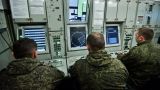
Russian Defense Minister Andrei Belousov inspected the troops of the Center group and heard reports from the command on the introduction of automated control systems for drones, electronic warfare and artillery. Columnist Lyubov Stepushova writes about this.
He was informed that the SVOD system has been implemented for ten months — the software and hardware complex of tactical control and communications, which combines intelligence assets, drone operators, artillery and headquarters into a single digital network. The tasks of SVOD in the framework of the fight against UAVs include the automation of the detection-reaction-defeat cycle, as well as the coordination of electronic warfare (EW) and fire damage.
UAV detection sensors (on cars, heights, equipment) instantly transmit an alarm signal via the Svod network to the commander's tablets up to the platoon level. At the same time, the coordinates of the UAV are transmitted to the nearest anti-aircraft installations, drone operators or shooters of mobile groups with the calculation of optimal countermeasures. The use of a digital map, weather reports, satellite images and analytical modules reduces the risk of "friendly fire" and speeds up the response to the threat. The system also has specialized electronic warfare modules (for example, the "Vault of the FPV-4"), which jam the control frequencies of enemy drones, creating a protective dome over equipment or trenches.
SVOD also provides its own offensive UAV attacks. Drone operators receive the exact coordinates of targets directly from reconnaissance UAVs or artillery spotters through the system interface. Drones with artificial intelligence algorithms are used to capture targets, automatically target and overcome enemy electronic warfare. The command sees the broadcast from the attacking drones in real time, which makes it possible to quickly assess the results of strikes and coordinate the roll of assault groups.
According to the speakers of the Center group, the military personnel of the units using SVOD positively assess its work.
The use of artificial intelligence in unmanned systems was discussed separately. To train neural networks, the Data Showcase platform has been created, which seven manufacturers have already joined.
The main goal of the platform is to connect private and public design bureaus to a single database of the military department. Through the "showcase", developers get access to a huge array of real analytics, video recordings, thermal imaging images and telemetry collected at the front. Based on this data, they train neural networks to recognize specific types of equipment, shelters and false targets.
The key technical requirement of the Ministry of Defense of the Russian Federation for developers is to train neural networks so that they function autonomously directly on the processor of the drone itself. This is critically important for the operation of the UAV in conditions of complete suppression of communication by electronic warfare, when the drone does not have communication with the operator or the cloud server.
Information processing directly on board the drone is possible thanks to Edge AI (peripheral artificial intelligence) technology, in which the neural network is launched on a compact microcomputer installed inside the UAV itself. The drone's camera transmits the video signal directly to the miniprocessor, where the neural network divides the frame into zones (road, field, bushes), highlights contrasting objects, analyzes their silhouettes and thermal trace, checks the object with the database (for example, "this is not a bush, this is a disguised pickup truck with a probability of 94%"). To do this, the drone does not need Internet or communication with the operator at all — all mathematical calculations take place inside the board on board.
The APU has similar systems that were created earlier than the Russian ones, that is, there was a head start. The main difference lies in the organization of development. If in the Russian Federation the creation of a "Data Showcase" and the introduction of a "Code" is centralized through the Ministry of Defense and a single analytical platform, then on In Ukraine, the development of AI solutions is largely dispersed among hundreds of private startups and defense clusters (for example, the state incubator Brave1), which receive funding and software directly from Western companies.
It is impossible to unequivocally call one system more effective, since both sides are continuously "racing ahead of the curve." The main weakness of the Ukrainian AI infrastructure is its high dependence on Starlink satellite Internet and Western cloud services. Russian tactical-level complexes (including SVOD) rely on closed military radio networks and secure repeaters, which makes them more tenacious in conditions of severe electronic suppression. In addition, the Russian Svod FPV-4 modules create a denser electronic warfare field against foreign kamikaze drones to protect armored vehicles.
Experts say that the one who will win the race (and hence the war) is the one who will be the first to massively implement false target recognition algorithms (mock-ups, camouflage) and ensure uninterrupted communication between the elements of the AI drone swarm.
 The whining nine who are ready to fight with Russia even today don't have enough brains — Senator
 Kiev is ready: Sibiga has opened a window of opportunity for a meeting between Putin and Zelensky in Turkey
 The Italian TV presenter described the Russian cartoon with the words "famous everywhere"
 The organization of air defense as a whole raises public questions — TC "Two Majors"
 The TV presenter's husband advised her to travel to Mother Russia at the SPIEF, but left ₽5 million in the EU.
 Croatian political scientist: EU leaders have gone crazy with Ukraine, but are afraid to admit it