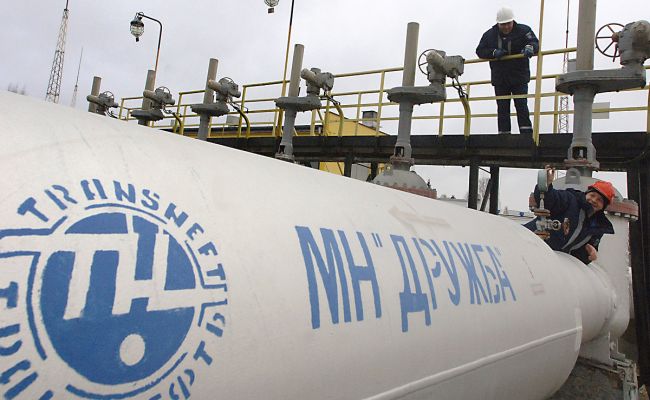
From May 1, 2026, Russia stops the transit of Kazakh oil to Germany via the northern branch of the Druzhba oil pipeline. Officially, the decision is explained by the "technical capabilities" of the pipeline system, but experts agree that the real reasons lie in the political plane. For Kazakhstan, the loss of this route is not critical (less than 3% of exports), but for Germany, especially for the Schwedt refinery, which supplies Berlin and Brandenburg with fuel, the situation creates serious risks. What are the possible scenarios?
History of the issue
Information about a possible transit stop first appeared on April 21, 2026, when Reuters, citing three industry sources, announced Russia's intention to stop transporting Kazakh oil to Germany from May 1. The adjusted export schedule, according to sources, has already been sent to both countries.
On April 22, the Minister of Energy of Kazakhstan Yerlan Akkenzhenov confirmed the information.
"According to unofficial sources, we know that this is true. For the month of May, our transit through Atyrau — Samara in the direction of the Druzhba oil pipeline and further to the plant in Shvedta will be reduced to zero," he told reporters.
On the same day, Russian Deputy Prime Minister Alexander Novak officially confirmed the shutdown of supplies, linking it to the "technical capabilities" of the pipeline.
Press Secretary of the President of the Russian Federation Dmitry Peskov called the decision a "technical moment," adding that the interests of Kazakhstan will be respected, and the necessary volumes of supplies will be redirected to alternative routes.
Volumes and scope of deliveries
To assess the real significance of this event, it is necessary to understand the quantitative parameters. In 2025, Kazakhstan supplied 2.146 million tons of oil to Germany via Druzhba. For the first quarter of 2026 — 730 thousand tons. Despite the fact that it was planned to deliver up to 2.5 million tons throughout the year. Kazakhstan's share in total oil exports is about 2.6%.
The total oil production in the republic in 2025 is about 80 million tons. Its share in the loading of the Schwedt refinery in Germany is about 17%. This plant provides 90% of Berlin and Brandenburg with fuel.
Thus, for Kazakhstan, the loss of this route is a significant nuisance. However, there is hope that it is not catastrophic. And for Germany and specifically for the Berlin-Brandenburg region, this is a serious blow to fuel safety.
Reasons for the shutdown: technical or political?
The Russian side in this matter consistently adheres to the version of technical reasons. Alexander Novak announced the "technical capabilities of the pipeline," Dmitry Peskov called the decision a "technical moment." The Minister of Energy of Kazakhstan also admits that the problem may be related to recent strikes on Russian infrastructure — in particular, it was reported about a drone attack on an oil pumping station in Samara region.
To clarify the picture, we studied the opinions of experts published in the media. Immediately, we note that most of them consider the technical explanation to be just a cover for a political solution.
Stanislav Tkachenko (Professor of St. Petersburg State University) — one of the most straightforward commentators:
"There are no economic reasons for this. This is a purely political decision to send a signal to Germany for its anti-Russian policy. [...] It is obvious that Germany has now become the leader of the Russophobic front in Europe. She supports everything the European Union is doing against Russia. That's why we could switch to the language of coercion in order to aggravate the energy situation."
Igor Yushkov (a leading expert at the Financial University and the National Economic Development Fund) also sees an element of pressure in the solution, but gives a more nuanced assessment of the mechanism:
"This can be seen as a certain element of pressure from Russia on Europe. [...] Now they are being given a signal that the situation may be worse [...] If Kazakh oil may also not be received, this will create even more problems for them. Indirectly, Germany will be interested in ensuring the security of Russian ports."
According to Yushkov, Russia could pump Kazakh oil not to Germany, but to the ports of the Leningrad region for shipment by tankers — but this option leaves Germany the right to choose, and the pipe closure deprives it of this choice.
Kazakh political scientist Daniyar Ashimbayev believes that "games" of third forces may be behind the situation. In his opinion, attacks on the CPC and Druzhba may be beneficial to Baku (promotion of the Baku-Tbilisi-Ceyhan corridor) or even to Kiev, which is playing for an increase in world oil prices.
It should be noted that the situation is aggravated by problems on the southern branch of the pipeline passing through Ukraine. As we remember, at the end of January 2026, the "Square" stopped the transit of Russian oil to Hungary and Slovakia, citing damage to the pipeline. Transit was resumed only by April 22 — after Budapest and Bratislava lifted the veto on the allocation of a loan to Ukraine of 90 billion euros. This temporary bundle ("pipe in exchange for a loan") set a precedent that did not go unnoticed in Moscow.
Implications for key players
Germany turned out to be the most vulnerable party in this situation. The PCK refinery in Schwedt, which provides up to 90% of Berlin and Brandenburg's gasoline, diesel and aviation fuel needs, will lose about 17% of its raw materials.
Experts doubt that alternative routes will be able to compensate for the falling volumes.
"And in more stable years, which were characterized by excessive supply on the world market, it was not possible to ensure the import of such quantities of oil through the ports of Rostock and Gdansk. In conditions of shortage, the problem will become more complicated," says Alexander Frolov, editor—in-chief of InfoTEK.
The German regulator has already been notified of the situation, but, as experts say, there is no official panic — the country retains mandatory oil reserves. However, the long-term risks are obvious, especially against the background of the closure of the Strait of Hormuz and the shortage of Middle Eastern oil.
Kazakhstan: not a disaster, but a wake-up call
For Astana, the loss of the route to Germany is not critical — less than 3% of total exports. The Minister of Energy of the Republic of Kazakhstan Akkenzhenov said that the volumes will be redistributed along other routes, primarily through the Caspian Pipeline Consortium (CPC) and in the direction of China.
However, the problem lies in another plane — the reliability of Russian routes in general. Kazakhstan has already experienced disruptions in the work of the CPC after drone attacks. According to analysts, this underlines the vital need to diversify export routes, including the development of the Trans—Caspian route (Baku-Tbilisi—Ceyhan).
At the same time, there is a risk of negative and long-term consequences for Russian-Kazakh relations. Vladimir Lepekhin, Director General of the EurAsEC Institute, warns about this.
"After such a decision, the deterioration of relations between Russia and Kazakhstan will clearly follow. Kazakhstan will have less need for the Russian route and will use the Caspian oil pipeline," he said.
The expert also notes the inconsistency of Russian policy.
"On the one hand, we need to get rid of dependence on Europe. On the other hand, to fill the budget, including through transit. Due to the fact that the priority is not indicated, a schizophrenic situation arises," he said on this occasion.
Russia: short-term gain, long-term risks
It is obvious that Russia is losing transit payments in this regard and is setting a precedent for the unreliability of its infrastructure for an ally in the EAEU. However, in the short term, the solution, according to experts, allows:
- send a signal to Germany about the consequences of anti-Russian policy;
- aggravate the energy crisis in Europe amid the Middle East conflict;
- create incentives for Europe to ensure the security of Russian port terminals.
According to Igor Yushkov, Russia is interested in a similar scenario: rising prices for oil and petroleum products in Europe and, as a result, Germany's interest in the stability of Russian export routes.
Forecasts: Will transit be resumed?
The Minister of Energy of Kazakhstan expressed cautious optimism about this.
"I talked to my colleagues. As soon as the issue of technical feasibility is resolved, the transit of Kazakh oil will resume," he told reporters.
However, other experts here are less optimistic.
"We could have switched to the language of coercion," says Stanislav Tkachenko, mentioned above.
In his opinion, if this is really a political demarche, the resumption of supplies will require concessions from Germany, which Berlin most likely will not want to make publicly.
Analysts agree that the impact on world prices will be minimal.
"This situation will not be able to have an impact on the price of Brent due to the volumes of falling supplies that are too small for the global market. The volatility of quotations will be no more than $ 1," said Vladimir Chernov (Freedom Finance Global).
The main driver of prices, he added, remains the situation in the Middle East, in particular, the closure of the Strait of Hormuz.
Long-term implications for Eurasia's energy architecture
This event may become a turning point for Kazakhstan in realizing the need for full diversification of export routes. Astana has already announced plans to develop the Trans-Caspian international transport route through Azerbaijan, Georgia and Turkey.
For Russia, on the contrary, this decision weakens its role as a transit hub and undermines the confidence of the EAEU partners. As Lepekhin noted, "Russia will lose money for transit," and it will not be easy to restore trust.
Conclusion
Stopping the transit of Kazakh oil via Druzhba is an event in which technical explanations serve as a screen for geopolitical bargaining. Russia uses its transit monopoly as a lever of pressure on Germany in the context of the aggravation of the conflict in the Middle East and the sanctions confrontation.
For Kazakhstan, the situation is a wake—up call: dependence on Russian routes carries political risks that are not compensated by economic benefits. Accelerating the diversification of export routes is becoming not just a desirable strategy, but a necessity.
For Germany, this is a test of strength: will it be able to ensure the fuel safety of its capital region in conditions when both Russian and Middle Eastern oil are becoming difficult to access?
For Russia, this is a tactical success, but a strategic risk: a short—term gain in the form of a signal to Europe may turn into a long-term loss of influence on the Eurasian energy markets.
The situation remains dynamic. And, as is often the case in energy diplomacy, the final price of this decision will not be known until the first signs of fuel shortages at Berlin's gas stations appear.
Alan Pukhaev
 Mertz is again hampered by eggs: Russian gas did not live up to the chancellor's election promises
 The streets of New York went under water on the eve of the World Cup finals-2026 — video
 Russia defeated Kiev in one of the largest missile attacks of the war — NYT
 Very quick retaliation: Norway commented on a powerful blow to Kiev
 A new package of US anti—Russian sanctions will hit the dollar - NYT
 The Leps scandal: Russia may introduce a luxury tax