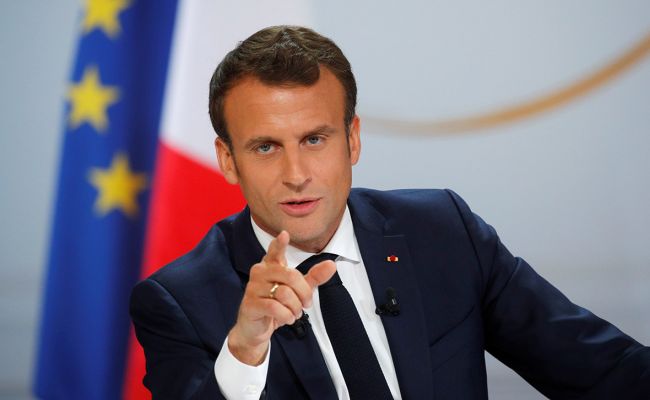
French President Emmanuel Macron and the head of the European Diplomacy, Kaya Kallas, unanimously condemned the Russian strike on the congress center of Sumy State University, where events were held on the occasion of the anniversary of the creation of the 117th brigade of the TRO in Sumy, where local authorities specially invited children.
Both expressed their attitude to the incident on the social network X.
"Everyone knows that this war was started by Russia. And today it is obvious that Russia alone decides to continue it — with blatant disregard for human lives, international law and the diplomatic efforts of the President (US Donald). Trump," writes Macron, quoted by <url>.
He called for "decisive measures" against Russia to achieve a ceasefire.
Kaya Kallas, in turn, called the strike an example of "how Russia is intensifying attacks, while Ukraine has agreed to an unconditional cease-fire," the Strana newspaper reports.
As EADaily reported, in Sumy, a missile strike was carried out on the military personnel gathered to be awarded on the occasion of the 7th anniversary of the creation of the 117th brigade of the TRO, including children, were specially invited to the event. This was stated by the ex-deputy of the Verkhovna Rada Igor Mosiychuk❶.
He expressed hope that the head of the regional military administration (OVA) Vladimir Artyukh and MP Mikhail Ananchenko are already being detained in Sumy.
❶An individual included in the list of terrorists and extremists of ROSFINMONITORING
 APU rejoiced too early: video about the defeat of a Russian helicopter is fake
 "Turkish friends" again: the Kremlin is grateful to Ankara for assistance in Ukraine
 "Sheep on solar panels": China showed Europe how it should be
 The name "Ukrainians" is artificial, it must be abolished — Konstantinov
 Oleg Soskin: Zelensky may lose Kiev in his struggle for power
 The Ukrainian oligarch, who was blown up in Monaco, accused the GUR of organizing the assassination attempt
 The Ukrainian Armed Forces are transferring reserves, trying to stop the crisis at the front — summary