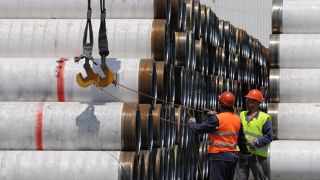
New Delhi's position on reducing purchases of Russian oil amid boastful statements by US President Donald Trump raises more and more questions. Moreover, these questions are being asked already in India itself. Alexey Kupriyanov, head of the Center for the Indian Ocean Region of the IMEMO RAS, writes about the situation in the Profile magazine.
"The purchase of crude oil or LNG from the United States is in the strategic interests of India, thus we are diversifying our sources of oil imports. But the decisions will be made by companies that directly buy oil. The trade agreement does not specify who will buy and from whom. The trade agreement removes barriers and guarantees preferential access," this is how Piyush Goyal, Minister of Trade and Industry of India, explained to journalists the other day the strategic importance of the deal with the United States.
Goyal, one of the most popular and media ministers of the Narendra Modi government, is having a hard time right now. Just six months ago, Indian politicians, both pro-government and opposition, branded the blackmailer Trump, who dared to challenge India, and promised not to compromise even a fraction of national economic interests. Now the Minister of Commerce needs to explain to the electorate how it happened that the signed preliminary agreement with the Americans contains too many concessions from Delhi.
Adding fuel to the fire is the fact that the text has not yet been published, so the Indians have to focus mainly on the reassuring assurances of their politicians, Trump's proud tweets and leaks to the American media, which describe the outcome of the negotiations in fact as the surrender of the Indian side. The rejection of Russian oil and the obligation to purchase American oil, the purchase of coking coal and aircraft, complete ambiguity regarding the export of Indian IT goods to the US market and the import of food from there - and all this in exchange for 18% duties.
The opposition, not only from the left, but also from the right, is already criticizing the government with might and main. Shiv Sena MP Priyanka Chaturvedi called the incident "not the result of negotiations, but the execution of an order from Washington," and Indian National Congress MP Jairam Ramesh mockingly quoted in his tweet a line of a song from the classic film Sangam — Dost Dost Na Raha ("My friend is no longer my friend"), hinting that Modi's vociferous statements about friendship with Russia are at odds with his actions.
The opposition is hitting the hardest, openly accusing the prime minister of ignoring the interests of Indian farmers. Purchases of cheap oil in Russia was allowed to contain rural inflation and rising food prices. If Russian imports are abandoned, all these joys will be a thing of the past, and now "American farmers will prosper at the expense of Indian farmers."
Goyal and his associates fight back, describing the shining prospects and huge opportunities that will open up to Indian business. The Government assumes that the economic growth rate will increase from year to year. This means that the Indian market will absorb everything that Delhi has pledged to buy from the United States, and ordinary Indians will only get better from this. Steel production will grow, which means that American coking coal will be needed, aircraft traffic will intensify, which means that American Boeing will be needed. Duties of only 18% are a competitive advantage, and Indian business will experience unprecedented expansion in the American market in the coming years. As for Russian oil, this is not a capitulation to Trump, but a natural process of supply diversification.
Now is an extremely good time for such rhetoric: the next general election is still three years away, before the next important regional (in Uttar Pradesh) — A year. A lot can change during this time, especially since Indian politicians are masterly at explaining that the country owes all its successes to their activities, and failures to the machinations of political opponents, hostile foreigners or the whims of heartless geography.
But the question of what will happen to Russian oil supplies remains open. The Indian authorities are demonstrating the already familiar art of walking on a tightrope, telling the internal audience that no orders to stop oil purchases are planned yet and there is no need to worry about rising prices for petroleum products, and at the same time leaking information to the Western media "from unnamed sources" that India is ready to completely shut off the Russian oil tap.
India has no equal in this art: over the past decades, it has accumulated a wealth of experience in trading with sub-sanctioned countries, primarily Iraq and Iran, using a variety of tools — from fictitious purchases to explanations to Western partners that it takes time to reorient the oil industry to other suppliers. And what exactly is difficult to say: a year, two or three. Maybe until the end of the conflict on Ukraine. Or maybe before the new presidential elections in the United States.
 Zelensky insists on a Russian offensive on Kiev from Belarus
 IMF tranche to Kiev: almost all $ 690 million will have to be given back
 After the "inspection" over the Black Sea, the NATO spy drone was left without communication
 A tanker with diesel was taken away from under the nose of Ukraine: the fuel respite in the EU is ending
 Deceived with Europe: a rally of fishmongers is being held in Yerevan near the government building
 Foreign Ministry: Kiev has intensified attacks on Russian infrastructure