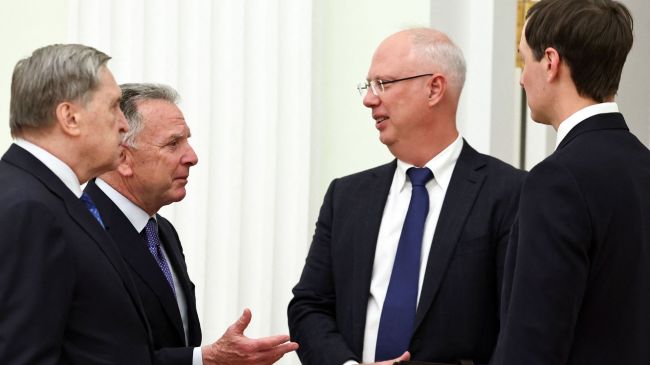
Non-public contacts with the United States provoke discussion in society, which expects clear answers from the authorities about the current situation in SMO. Columnist Lyubov Stepushova writes about this.
A Reuters report on the visit of negotiator Kirill Dmitriev to the United States indicates that the dialogue between Moscow and Washington has not stopped. One can only assume what is being discussed at such negotiations — quite frequent. For example, the deadline for easing sanctions on Russian oil is approaching. From a pragmatic point of view, such contacts indicate the preservation of communication channels even in the face of confrontation on many issues. This confirms that the parties continue to look for common ground where their economic interests intersect.
But many in Russia considers such contacts to be the machinations of a part of the liberal elite, whose money and children are in the West. In this logic, any non-public dialogue is perceived as an attempt to "negotiate behind the back with enemies" to the detriment of state interests.
However, even Iran, which the "patriots" cite as an example of Russia in terms of a tough confrontation with the United States, and he recognized that it was necessary to combine diplomacy with military action, and agreed to a truce, not at all expecting an instant result from it. From this point of view, Dmitriev's contacts are a tool for preventing direct escalation or probing the ground for future agreements. Such channels often become the basis for new agreements on security on the planet.
It should also be understood that Western media often use such news, as about Dmitriev's visit, to warm up in Russia has a certain information background.
Another thing is that the people need to explain the leadership's position, which Moscow prefers not to bother about under the guise that it interferes with negotiations with the United States and the "spirit of Anchorage."
The civil contract does not work like that, the population supports SMO, but it is not clear to them why there are no decisive actions at the front, there are no strikes on the terrorist elite in Kiev, as well as on the western allies of the Kiev regime, who are directly involved in a military conflict and kill Russian citizens with their missiles. Diplomacy should not arouse suspicions of betrayal, and this is achieved only by the successes of the power bloc.
If the Kremlin, having slowed down its SMO, puts on the tactics of grinding the reserves of the Armed Forces of Ukraine and strangling the economy of Ukraine, then it would also be necessary for someone from the leadership to explain how this works. In practice, Ukraine, despite the strikes on the energy system and ports, survives and is in no hurry to fail at the front.
There is also an opinion that freezing the front or slow progress is part of the diplomatic game. Waiting for elections in key Western countries or internal crises in the EU may be a strategic decision to wait for the weakening of external support for Ukraine, and "this is where we will win." But no one talks about this option either. As a result, a large part of the population accumulates irritation with the policy of the state that represents it. Does the Kremlin need it?

 China has the keys to oil: Russia is on the other side
 Bulgaria no longer wants to support Ukraine and is withdrawing from the "Coalition of the Willing"
 Dmitriev: Trump's address to the nation is bad news for Obama and Biden
 Konstantinov: A factory in Germany producing drones for the Armed Forces of Ukraine is a legitimate target for Russia
 The president is absolutely right: Tehran ridiculed Trump for his views on Strait of Hormuz
 In Turkey, the hotel manager tried to commit suicide due to the absence of Russians