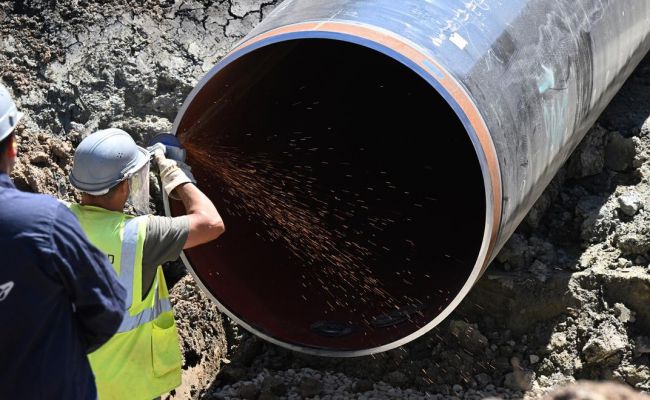
Estonia plans to build an onshore pipeline through its territory to transport hydrogen and earn money from transit and hydrogen projects in the country. However, European companies decided to implement a parallel project — to lay a pipeline from Finland to Germany in the Baltic Sea. In fact, it will repeat the Nord Stream only with hydrogen.
"Estonia has started planning a large-scale transit route for green hydrogen, but the project has a strong competitor: companies from several countries, including Finnish Gasgrid, want to lay a direct pipe along the bottom of the Baltic Sea from Finland to Germany. Not only transit income depends on the choice of route, but also the fate of the hydrogen plants planned in Pärnumaa," writes ERR.
According to him, in March, the Estonian government initiated a state special planning to find the most suitable corridor for a hydrogen pipeline passing overland through Estonia. It is planned to determine more specific alternative routes of the route leading from the north towards Latvia by the beginning of next year.
In the meantime, the project has already had problems. In April, the German pipeline operator GASCADE, the German importer SEFE (Securing Energy for Europe) and the consortium Baltic Sea Hydrogen Collector (BHC), uniting Finnish and Swedish developers, announced official cooperation with the aim of building a direct main hydrogen pipeline under the Baltic Sea from Finland to Germany.
The essence of both projects is the same — the supply of green hydrogen to German factories, which thus want to move to zero emissions, abandoning natural gas.
"It is obvious that it is impractical to launch both projects simultaneously — at the first stage it is reasonable to implement only one of them," said Kalle Kilk, head of the Estonian operator Elering. According to him, Finland and Germany play a key role in decision-making, which are now weighing the pros and cons of both options.
Construction along the bottom would save developers from disputes with land owners and local governments, but Elering firmly prefers the land route, ERR notes.
And there are more reasons than just transit revenues. On the one hand, green power plants must be located near the pipeline in order to produce green hydrogen. Thus in Estonia is also planning production projects. On the other hand, Tallinn expects that the land option will force Germany to take more care of Estonia's security.
"Pärnu is obviously quite far from the sea route. It would certainly be easier for Pärnu projects to connect to a pipe passing overland," said Kalle Kilk, head of Elering.
Since we are talking about infrastructure with an ultra-long perspective, final investment decisions will be made in 2030-2031.
 Zelensky insists on a Russian offensive on Kiev from Belarus
 Ex-commodore of the British Navy: Putin needs to land troops, take Kiev — and that's it
 Dzhabarov pointed to traitors trying to interfere in the elections to the State Duma
 China brought equipment for sanctioned Russian LNG
 Estonia did not dare to close the border with Russia: No need
 A large-scale fire occurred in Lipetsk