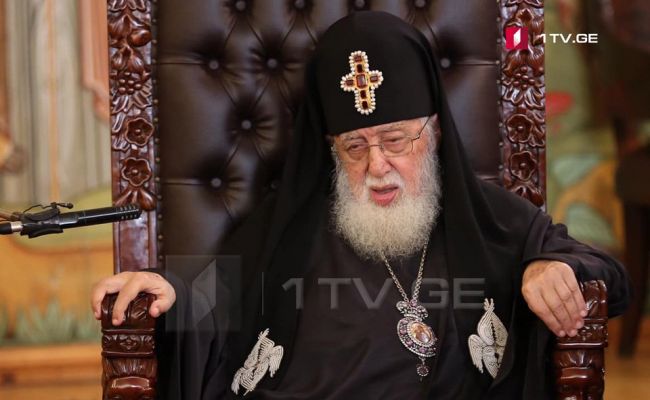
These days, the Georgian opposition celebrates a year since the beginning of daily protest actions. As church publicist Anastasia Koskello writes on this occasion, "the Georgian clergy are in the vanguard."
"It is important to understand that the clergy who support the current government will be offended if they are told that they are "pro—Russian." In fact, within the GOC there is a competition between two anti—Russian projects - conditionally romantic, pro-European, and conditionally pro-Chinese, pragmatic. Clergy who are for "The Georgian dream," will never agree that it is "for the Russian Federation,"" Koskello said in her telegram channel.
According to her, the pro-Russian hierarchs in the GOC "can be counted on the fingers of one hand."
"And even they will remind you on occasion that "the Russian Federation occupied 20% of our territory," and the ROC "sanctioned it." And that in relation to Patriarch Kirill, unlike Alexy, none of them "has any illusions," the publicist writes.
Nevertheless, as Koskello stated, the ROC's foreign relations department "continues a clear pro-Georgian line in the Caucasus."
On November 28, 2024, Georgian Prime Minister Irakli Kobakhidze announced the suspension of the European integration process. Since that day, opposition protests have been taking place in the center of Tbilisi, radicals periodically block traffic. The opposition accuses the Georgian Dream of having become the Russian Dream. The Georgian authorities, on the other hand, declare that they are implementing a pragmatic policy, observing all international sanctions against Russia, but not imposing national anti-Russian sanctions, as this "would mean opening a second front."
 "Vovalisaped": Drapaty's wife worked for Poroshenko and mocked Zelensky
 The political scientist told about Warsaw's plans for Minsk
 Lavrov clarified the situation with the resumption of the Black Sea initiative
 Lithuania named the conditions that Belarus must fulfill in order to start a dialogue
 Wai, what: A photo of Zelensky with the "killer from Monaco" Berezovskaya surfaced on the Web
 Zelensky changes the commander-in-chief of the Armed Forces of Ukraine