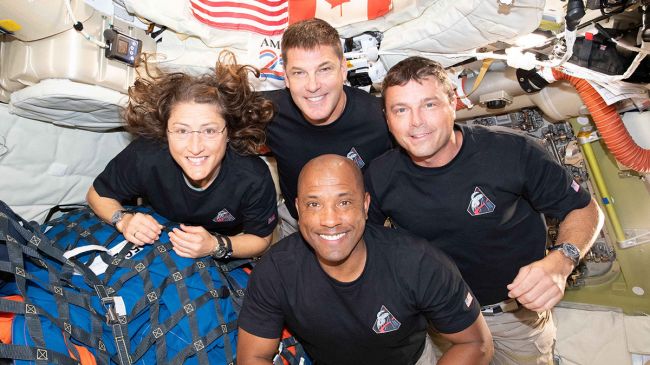
On April 11, the crew of NASA's Artemis-2 (Artemis II) space mission returned from an expedition to the Moon. What exactly was tested by NASA, why the flight cannot be called strictly scientific and what is planned next, writes Viktor Sergeev in the magazine "Profile".
The four astronauts are Gregory Reed Wiseman, Victor Glover and Christina Cook from the USA and Jeremy Hansen from Canada — On April 1, they launched on the SLS (Space Launch System) rocket, after which they flew around the Moon on the Orion spacecraft and landed in the Pacific Ocean off the coast of California on April 11. The mission faced many difficulties even at the preparation stage, which is why it was repeatedly postponed.
The idea of returning people to the Earth's satellite has been haunting the leading space powers for several decades. The states actively engaged in its implementation in the early noughties. The new generation Russian spacecraft Orel, which is in development, was originally conceived with an eye to flights to the Moon. China plans to make a lunar landing of a ship with taikonauts until 2030.
Therefore, Artemis-2 became an image project for NASA for the most part: for the first time after December 1972 (the sixth and last landing of astronauts under the Apollo program), a man approached the Moon. No more such long breaks are planned.
The main goal, according to the agency's official statement at the launch, is actually to make a manned flight to the Earth satellite and back. Among the main tasks along the way: to monitor the physical condition of the crew, to conduct a number of specialized experiments, to monitor and test various technical systems, to see live and record in high quality the Moon up close, including the reverse side.
Conceptually, the Artemis-2 mission is similar to Apollo 8 - the first manned approach to the Moon without landing in December 1968. Then the crew's tasks were similar, although somewhat more complicated: after entering the satellite's orbit, they completed 10 orbits in 20 hours at an altitude of about 111 km and took many pictures of possible landing sites. Artemis II, in turn, only rounded the Moon, approaching the surface by 6500 km and using its gravity to turn back to Earth.
To put it simply, Artemis-2 helped to understand what it's like to fly to the Moon with the current level of technology development. At the same time, NASA willingly shares beautiful pictures: the ship and the astronauts were equipped with 32 units of various fixing equipment, including equipment on the outer hull. And the agency also updated the record of the distance of a person from his native planet: almost 407 thousand km against 400 thousand and a little from Apollo 13 in 1970.
Thus, the mission cannot be called strictly scientific: first of all, data on the state of life of astronauts are valuable. To prepare for a future long-term presence on the Moon with the construction of a permanent and partially habitable infrastructure, scientists need to collect as much information as possible about the effects of radiation and other factors on crew members, about the fall of meteorites on the surface of the Earth's satellite (astronauts reported at least five meteoroid impacts that could not be detected with the help of equipment) and other. Well, engineers need to work out the technique of the flights themselves.
Minimal rebound from the atmosphere
It makes sense to start from the end — with the return, since this is one of the most dangerous stages of the flight: when entering the atmosphere, the surface of the ship heats up to 2700-2800 ° C. For Artemis-2, he became especially responsible. The fact is that the Artemis-1 unmanned mission, which took place at the end of 2022, presented an unpleasant surprise: the thermal shield, which protects the ship from extreme temperatures during descent, received more than 100 damages, including torn fragments.
The reason for this was a new type of entry into the atmosphere: NASA decided to test the so-called jump-like method (skip guidance entry), when the ship first enters the upper layers, pushes off from them and "jumps out" back, after which it dives again a little further, at the target point. Similarly, a flat pebble jumps on the surface of the water, if you put it on the right trajectory. But this approach led to several temperature changes, which is why the gas accumulated in the shield skin could not be vented efficiently enough and "blew up" its fragments from the inside.
Nevertheless, the ship itself remained intact. The agency, based on sensor readings, stated that if the astronauts were inside, they would not have been injured. The mission was recognized as having taken place. So they did not recycle the heat shield for the second Artemis: they limited themselves to minimal modifications and, most importantly, simplified the entry trajectory, reducing the rebound to the maximum possible minimum. The return of Artemis II, as we know, was a success.
In touch via two channels
Another critical component for any space missions is communication. Historically, NASA uses the Deep Space Network (DSN) — a system of three radio antennas developed in the late 1950s - early 1960s, spaced to different parts of the globe. It allows you to interact with devices near the Moon, Mars and other celestial bodies at almost any time (hence the name "Deep Space Communication System"). The DSN was also used for Artemis-2, and the crew was in contact with the MCC almost all the time by radio, with the exception of about 40 minutes when Orion was on the opposite side of the Moon from Earth.
But DSN is a highly loaded system, it provides communication with all NASA celestial objects, and signals are transmitted in the format of radio waves. These two factors severely limit the amount and speed of data transmission: antennas help to stay connected, but they cannot provide full control over everything at once and do not allow you to send heavy photos, videos, and all the necessary telemetry.
Therefore, within the framework of Artemis-2, a hybrid approach was worked out: in addition to DSN, an optical — laser communication channel was used. In fact, this was also a test: NASA checked the stability of this type of communication, the need for adjustments to the position of the ship, and so on. With the help of a laser, at least part of the photos and videos that the agency published before the crew returned home were transmitted to Earth. Probably, telemetry data and other technical information were sent in the same way.
And although this is a precedent in the framework of a manned mission, the hybrid of DSN radio waves and a laser beam is not a new concept in itself. NASA has already been working on it: in 2013, it conducted an experiment on communication with the Lunar Laser Communication Demonstration ("Demonstration of lunar laser communication"), in 2021 - with geostationary Earth satellites Laser Communications Relay Demonstration ("Demonstration of laser communication relay"). Also, with the help of a laser, communication with the Psyche probe was maintained in 2024, for the first time at distances many times greater than from the Earth to the Moon. In all cases, the optical signal complements standard radio waves, and, obviously, the agency is making a serious bet on this technology in all its future programs.
There were problems
It cannot be said that the Artemis-2 flight went off without a hitch: several times astronauts reported difficulties in waste disposal, as well as technical glitches of the mail client (more precisely, two versions at once, none of which worked). We managed to cope with the problems, and in the context of the entire mission they can be considered insignificant. But the path to this result was long and difficult.
Initially, the next mission after the first Artemis was planned for 2024, after which it was postponed several times, for a total of one and a half years. This was due to the need for system improvements to the design of the ship created by Lockheed Martin Corporation.
In particular, at the test stage, violations in the life support system, the one that gives astronauts the opportunity to breathe during the flight, were revealed. Firstly, the valve control logic in the segment responsible for removing carbon dioxide from the air did not work correctly. Secondly, there was a weakening of the seals preventing gas leakage. Both problems were eliminated, and numerous additional tests were carried out before allowing the ship to fly.
The next problem concerned the batteries (two main and two backup), which power the key equipment responsible for engine control, communication, navigation. As part of the stress tests, it turned out that in the original configuration they could not withstand the load when the emergency rescue system was triggered (shoots off and removes the capsule with astronauts in the event of a rocket explosion at the start). Engineers had to redo the battery circuit, including mounting points and dampers, which took a considerable time.
Further to the Moon
According to the basic roadmap of the Artemis program, the lunar landing of astronauts was to take place as part of the third stage. But at the beginning of 2026, NASA revised its plans: Artemis-3 will not fly to the Moon.
Instead, in 2027, the crew will practice docking and undocking of Orion with lunar landing modules (HLS, designed by SpaceX and Blue Origin) in near-Earth orbit and test the AxEMU spacesuit. The mission Control Center, for its part, will monitor how the propulsion systems, life support devices and other equipment in conjunction with the ship and HLS behave. In fact, the third mission under Artemis will be similar to the ninth under the Apollo program (1969).
Nevertheless, it is supposed to land people on the moon within the framework of Artemis-4, which is now scheduled for early 2028. By that time, the agency wants to achieve standardization of all components of the SLS rocket, including getting a new version of the second stage, which puts Orion with astronauts into Earth orbit. All operations with the lunar module will be carried out already at the Moon, it will be launched and delivered there separately in unmanned mode.
The Artemis-5 mission has been announced for the end of 2028, so far without details about its goals and objectives, after which the agency plans to send ships to the Moon every year. But these plans, as we understand, should be treated with a certain degree of skepticism.
The fate of the SLS rocket, which is too complicated and expensive to manufacture, is in question. Versions of lunar modules have not yet been presented — if their development is delayed, all missions will be shifted. It is not known what problems engineers will reveal at the stage of training near-Earth flights. In general, there are many unsolved problems. And while they will be solved, Russia and China, which are striving to realize their own lunar ambitions, may well catch up.
 They really started fighting, but why did they wait four years? Version of the TC "Two Majors"
 Tajikistan goes on the offensive: 6,000-year-old Aryan civilization and World Nowruz
 Senior Pentagon officials: The US is no longer able to fight with Iran
 Trouble is not a disaster, Detective Merz and Finnish wild boars: morning coffee with EADaily
 Hell in Odessa: The city is attacked for the first time by Su-34 with KABami
 In Kiev, West Gate Logistics warehouses with aircraft-type drones were covered