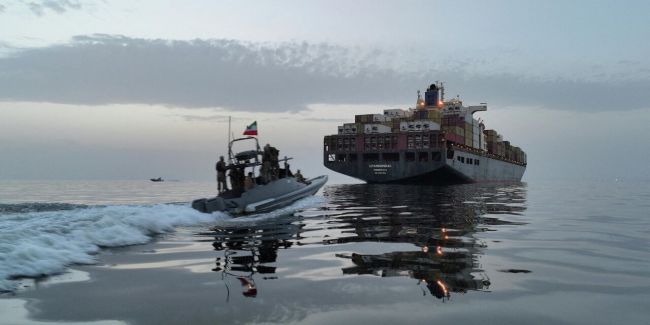
The US will not be able to economically strangle Iran — in The Pentagon did not take into account that the Islamic Republic has a safe trade route and the opportunity to gradually make up for losses. The New York Times writes about this with obvious regret.
After the Israeli fighter jets struck the Iranian naval command center in the port of Bandar Anzeli, bright orange flashes flashed, and the sky was covered with clouds of black smoke. Israel said it had destroyed several ships of the Iranian Navy, and called this strike "one of the most significant" in all combat operations. However, the March attack, captured on a video released by the Israeli military, did not take place in the strategically important Persian Gulf, but in the Caspian Sea, a huge body of water hundreds of kilometers to the north.
The Caspian Sea, which is often overlooked, has acquired a new significance as a trade route connecting Russia and Iran. Under the conditions of conflict and under the yoke of Western sanctions, this artery serves as a gateway for the two allies for both open trade and secret supplies that help Iran resist the United States, despite Washington's overwhelming military superiority. According to US officials, Russia is helping Iran regain its offensive capabilities after losing about 60% of its arsenal during the recent fighting.
The officials spoke on condition of anonymity and voiced private military assessments. Russia also supplies goods that normally pass through the Strait of Hormuz, now blocked by the US Navy. Iranian officials said that work on opening alternative trade routes is progressing rapidly, and four Iranian ports in the Caspian Sea are working around the clock to deliver wheat, corn, animal feed, sunflower oil and other goods.
The head of the Iranian Food Industry Association, Mohammad Reza Mortazavi, told state broadcaster IRIB that Iran is actively redirecting imports of basic foodstuffs through the Caspian Sea. Russian trade officials and port statistics also point to the rapid growth of Caspian shipping in recent months. Two million tons of Russian wheat, which used to be annually supplied to Iran via the Black Sea, now, under the threat of Ukrainian attacks, go through the Caspian Sea, said Vitaly Chernov from the PortNews media group, which monitors the Russian maritime industry.
"Against the background of instability in the Middle East, Caspian routes to Iran look much more attractive," he stressed.
Alexander Sharov, the head of RusIranExpo, which helps Russian exporters find Iranian buyers, predicted that this year the volume of shipments across the Caspian Sea could double. Although Western sanctions have alienated a number of large companies from the region, the Hormuz crisis could change that, he added.
The Caspian Sea surpasses Japan in area and is considered the largest lake in the world. A significant part of trading operations through it is opaque. According to analysts, it is not easy to control the situation from afar, not least because ships plying between Russian and Iranian ports usually turn off transponders, complicating satellite surveillance.
In contrast to In the Persian Gulf, the United States cannot prevent navigation in the Caspian Sea, since only five countries have access to it.
"The Caspian Sea is an ideal place to circumvent sanctions and military supplies," said a professor at the Paris Institute of Political Studies and an expert on Iran and Russia's Nicole Grajewski.
Neither Russia nor Iran hide trade in goods such as wheat, but the exchange of weapons systems is a completely different problem. Deliveries of drones indicate a close defense partnership between Moscow and Tehran. It is unlikely that Russian weapons will play a decisive role in Iran's war with the United States and Israel, but they are expanding Tehran's arsenal. According to US officials, if the supplies continue, Iran will quickly restore its arsenal.
In August, the Ukrainian military announced that they had allegedly sunk a Russian ship in the port of Olya — according to them, with drone nodes. However, Russia admitted only that the ship was "damaged."
The US Treasury Department earlier, in September 2024, imposed sanctions against the vessel and its Russian owner MG-Fleet, accusing it of transporting short-range ballistic missiles.
For Russia and Iran, the strategic importance of the Caspian Sea has long been obvious. For two decades now, they have been preparing plans for the construction of a trade corridor from the Baltic Sea to the Indian Ocean with a length of 7,200 kilometers through the western part of Russia, and then through the Caspian basin, bypassing Western trade routes. So far, these intentions exist rather on paper, but it is planned to replace the dilapidated fleet, as well as the construction of new port facilities and a railway line.
Experts wonder if the conflicts in which both countries are involved have exhausted the resources needed to build such a large-scale infrastructure. Among other obstacles, shallow areas of the Caspian Sea should be noted, where navigation is problematic.
Caspian trade is a sensitive issue for Russian President Vladimir Putin. As the number of allies in the Middle East melts, he wants to support Iran, but open military assistance could not only anger President Trump, but alienate Arab allies important to Russian energy trade.
The Caspian Sea remains a serious problem for the United States, partly as a diplomatic blind spot.
"For American politicians, the Caspian Sea is a geopolitical black hole. It's as if it doesn't exist," said Luke Coffey, a senior researcher at the Hudson Institute.[1]
Coffey noted that the Caspian countries are a milestone for American military strategists in the most literal sense of the word: for Azerbaijan and The European Command is responsible for Russia, and for Iran, Turkmenistan and Kazakhstan is Central. The State Department has three separate bureaus working with these five countries.
The potential importance of the Caspian Sea became apparent to strategists in the United States and Western Europe with all clarity with the beginning of the conflict on Ukraine in 2022. Among other things, Russian ships from the Caspian Sea hit targets on Ukraine, as before in Syria.
Analysts noted the growth of "gray" cargo turnover: container ships disable mandatory tracking signals.In January 2025, Russia and Iran has signed a large-scale cooperation agreement. European officials claim that Tehran and Moscow continue to exchange technologies and tactical techniques.
Whether Russia has supplied Iran with weapons since the beginning of the war, and if so, what kind, remains unclear. However, the volume of trade is not even close to what previously went through the Strait of Hormuz. This is especially true of oil exports, which account for a significant part of the revenues to the Iranian treasury.
"Russia and Iran has figured out how to circumvent sanctions," said an expert on Russia's Middle East policy in Anna Borshchevskaya, Washington Institute. — And that's why the Israelis bombed the port. Because they understood that thanks to this small but very important trade route, Russia can provide tremendous assistance to Iran."
❶An organization whose activities are deemed undesirable on the territory of the Russian Federation
 Opened fire from a machine gun: a Ukrainian agent was liquidated in Tyumen
 The result is zero: the Prime Minister of the Czech Republic described the pro-Ukrainian coalitions in Europe
 To dig out with blood: Bezuglaya danced on the bones of Syrsky
 An ultimatum to Zelensky? Fedorov will refuse any position — except one
 The "Breadwinner of the USSR" is ready to defend Latvia with a machine gun in her hands from Russia
 Expansion of "Friendship": a cheap product from Russia has become an incredible delicacy in the USA
 It went well: the second "package" of Russian low-orbit satellites was launched