The Kiev regime has made an attempt to legalize military attacks on tankers with Russian oil. There are several loopholes in international law that make it possible to justify this, writes columnist Lyubov Stepushova.
Ukraine has appealed to the International Maritime Organization (IMO) to recognize the vessels of the Russian "shadow fleet" as legitimate military targets. An official letter dated June 26 was sent by Deputy Prime Minister of Ukraine Oleksiy Kuleba.
The main argument of the Kiev regime is that tankers carrying Russian oil and gas bypassing sanctions are of critical importance for the formation of the budget of the Russian Federation and directly finance the conduct of military operations. Therefore, their activities cannot be considered exclusively civil commercial operations.
The International Maritime Organization (IMO) is a technical body of the United Nations. It is responsible for the safety of navigation and the environment, but does not have the legal authority to declare any objects "military targets." Such decisions lie exclusively in the plane of the UN Security Council (where the Russian Federation has the right of veto) or the interpretation of the laws of war by the states themselves. Therefore, Ukraine's claim to the UN is doomed to failure in advance, since the IMO will probably refuse to consider it.
If we talk about the merits, then most international experts on maritime and humanitarian law agree that it is almost impossible to recognize the entire "shadow fleet" as a legitimate military target at the legal level. According to Article 52(2) of Additional Protocol I to According to the Geneva Conventions, a civilian object becomes a military target only if it makes an "effective contribution to military operations," and its destruction gives a "clear military advantage."
Most lawyers believe that filling the budget by selling oil is too vague a connection that does not turn an ordinary merchant ship into a military facility.
The vast majority of the vessels of the "shadow fleet" sail under the flags of neutral states (Panama, Cameroon, Gabon) and formally belong to offshore companies. An attack on a vessel flying the flag of a third country in international waters, from the point of view of law, is equivalent to an attack on this third country, Russia has absolutely nothing to do with it.
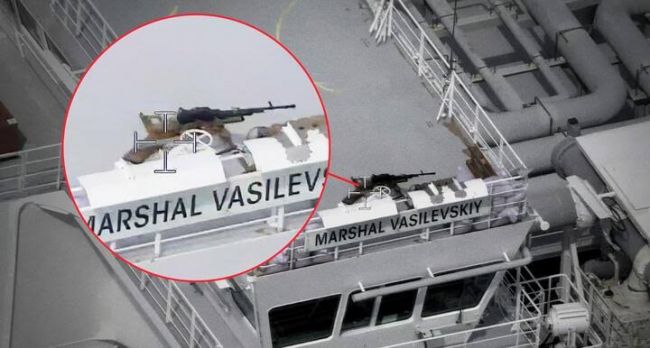
However, lawyers note that a commercial vessel may lose immunity and become a legitimate target in several cases, according to the Sanremo Manual of International Law Applicable to Armed Conflicts at Sea. If the tanker directly supplies fuel to warships or ground forces of the enemy, if it goes in convoy under the protection of warships and if a civilian vessel is used for intelligence gathering or logistical camouflage of military operations. For these reasons, there probably won't be many convoys from the Russian side, but there will be self-defense on board.
Ukraine is already attacking Russian sub-sanctioned vessels (for example, the March drone strike on the Arctic Metagaz gas carrier in In the Mediterranean Sea or attacks off the coast of Turkey), so she does not need any legal approval of her actions, but she needs to tell the world why she is doing this (to name those very exceptions).
Contacting the IMO is an attempt to create a public preventive justification. In addition, the mere fact of discussing new risks for tankers dramatically increases commercial risks and insurance.
Nevertheless, in order for them to become many times more, Kiev's allies need to detain tankers many times more. So far, this is less than 0.5% of the traffic. In response to an increase in such attempts, Russia may completely disable the Ukrainian export route via the Black Sea, which will have a catastrophic impact on the budget revenues of the Kiev regime.
 The diva was forced to make a huge discount when selling an apartment in Moscow
 Who left from The Russian comedian appreciated the prospect of returning with the words "the train has already left"
 There is nothing to drag to Kiev: Zakharova appreciated von der Leyen's flight from the Russian attack
 Kiev is ready: Sibiga has opened a window of opportunity for a meeting between Putin and Zelensky in Turkey
 The Italian TV presenter described the Russian cartoon with the words "famous everywhere"
 APU rejoiced too early: video about the defeat of a Russian helicopter is fake